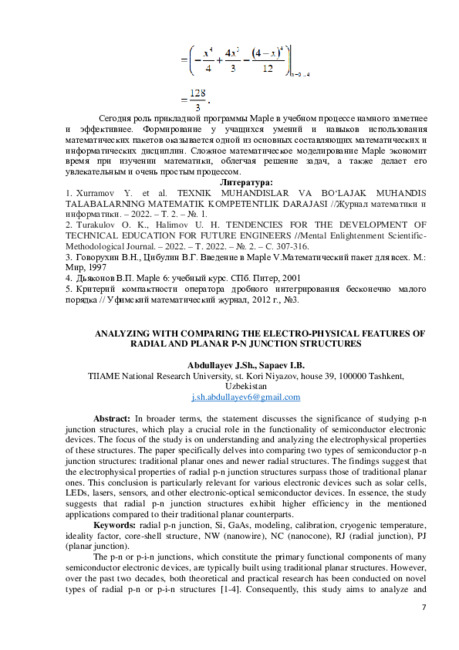


7
Сегодня роль прикладной программы Maple в учебном процессе намного заметнее
и эффективнее. Формирование у учащихся умений и навыков использования
математических пакетов оказывается одной из основных составляющих математических и
информатических дисциплин. Сложное математическое моделирование Maple экономит
время при изучении математики, облегчая решение задач, а также делает его
увлекательным и очень простым процессом.
Литература:
1.
Xurramov Y. et al. TEXNIK MUHANDISLAR VA BO‘LAJAK MUHANDIS
TALABALARNING MATEMATIK KOMPETENTLIK DARAJASI //Журнал математики и
информатики. – 2022. – Т. 2. – №. 1.
2.
Turakulov O. K., Halimov U. H. TENDENCIES FOR THE DEVELOPMENT OF
TECHNICAL EDUCATION FOR FUTURE ENGINEERS //Mental Enlightenment Scientific-
Methodological Journal. – 2022. – Т. 2022. – №. 2. – С. 307-316.
3.
Говорухин В.Н., Цибулин В.Г. Введение в Maple V.Математический пакет для всех. М.:
Мир, 1997
4.
Дьяконов В.П. Maple 6: учебный курс. СПб. Питер, 2001
5.
Критерий компактности оператора дробного интегрирования бесконечно малого
порядка // Уфимский математический журнал, 2012 г., №3.
ANALYZING WITH COMPARING THE ELECTRO-PHYSICAL FEATURES OF
RADIAL AND PLANAR P-N JUNCTION STRUCTURES
Abdullayev J.Sh., Sapaev I.B.
TIIAME National Research University, st. Kori Niyazov, house 39, 100000 Tashkent,
Uzbekistan
Abstract:
In broader terms, the statement discusses the significance of studying p-n
junction structures, which play a crucial role in the functionality of semiconductor electronic
devices. The focus of the study is on understanding and analyzing the electrophysical properties
of these structures. The paper specifically delves into comparing two types of semiconductor p-n
junction structures: traditional planar ones and newer radial structures. The findings suggest that
the electrophysical properties of radial p-n junction structures surpass those of traditional planar
ones. This conclusion is particularly relevant for various electronic devices such as solar cells,
LEDs, lasers, sensors, and other electronic-optical semiconductor devices. In essence, the study
suggests that radial p-n junction structures exhibit higher efficiency in the mentioned
applications compared to their traditional planar counterparts.
Keywords:
radial p-n junction, Si, GaAs, modeling, calibration, cryogenic temperature,
ideality factor, core-shell structure, NW (nanowire), NC (nanocone), RJ (radial junction), PJ
(planar junction).
The p-n or p-i-n junctions, which constitute the primary functional components of many
semiconductor electronic devices, are typically built using traditional planar structures. However,
over the past two decades, both theoretical and practical research has been conducted on novel
types of radial p-n or p-i-n structures [1-4]. Consequently, this study aims to analyze and

8
compare the advantages and disadvantages of traditional planar structures against radial
structures. In p-n and p-i-n junction structures, Poisson's equation is utilized to ascertain
electrophysical distributions such as electric field and potentials. Poisson's equation for planar
junctions (PJs) is expressed as follows (1) in the Cartesian coordinate system, whereas Poisson's
equation for radial junctions (RJs) is expressed as follows (2) in the cylindrical coordinate
system.
2
2
2
2
2
2
2
2
( )
( )
( )
( )
( , , )
r
r
r
r
f x y z
r
x
y
z
(1)
2
2
2
2
2
2
2
( )
1
( )
1
( )
( )
( , , )
r
r
r
r
f r
z
r
r
r
r
z
(2)
In theoretical research employing these equations,
r
represents the radial direction, and
θ
denotes
the azimuthal angle. Solving expression (2) presents greater challenges compared to expression
(1), resulting in fewer theoretical studies and articles on radial junctions (RJs) compared to
planar junctions (PJs). Figure 1 illustrates a schematic 2D cross-section of both planar and radial
p-n junctions. Typically, radial junctions have a cylindrical shape, while planar junctions are
cubic in shape.
Fig. 1. Schematic 2D cross-section of a) planar p-n junction and b) radial p-n junction.
The light grey area represents the n-type, while the dark grey area represents the p-type.
In considering the advantages and disadvantages of radial p-n and p-i-n junction
structures, it's worth noting that RJs find utility in micropillars [5] and nanowire (Nw) structures
[6]. These configurations offer significant surface area, a crucial aspect in sensors [7] and
photodiodes [8], where enhanced light absorption is essential. Moreover, RJs mitigate boundary
effects, reduce heat output, facilitating the design of high-power devices, and offer efficient heat
management. However, their extraction technology is complex and costly, and their
electrophysical properties tend to be non-uniform.
Conversely, when evaluating planar p-n and p-i-n junction structures, they boast ease of
development, influencing cost-effectiveness and mass production. They exhibit homogeneous
electrophysical properties and benefit from established technological development lines in
factories. Nonetheless, their smaller surface area can impact the performance of certain devices,
and they are susceptible to surface boundary effects.
An analysis of journals with high impact factors in Scopus and Web of Science reveals
that Silicon (Si) and Gallium Arsenide (GaAs) are commonly employed materials for Nanowires
(Nw) and Micropillars. The ionization energy of these materials holds significant importance in
understanding their electronic properties and device behavior. However, there has been limited
study regarding the ionization energy of materials utilized in Radial Junctions (RJs).
Table 1 presents a compilation of ionization energies and dopant elements for Si and
GaAs materials. This information serves as a foundational reference for further research into the

9
ionization energy of materials used in RJs, aiding in the exploration of their potential
applications and performance characteristics.
Table 1
Material
Donor
Energy
(meV)
Acceptor
Energy
(meV)
Si
Li
Sb
P
As
33
39
45
54
B
Al
Ga
In
45
67
72
160
GaAs
Si
Ge
S
Sn
5.8
6.0
6.0
6.0
C
Be
Mg
Si
26
28
28
35
One of the crucial electrophysical parameters of semiconductor p-n junction structures is the
ideality factor. The ideality factor is expressed as equation (3):
( )
ln(
1)
p n
S
U
q
m
I U
kT
I
(3)
Where
m
is the ideality factor,
I(U)
is the forward bias current through the diode,
I
s
is the reverse saturation current,
q
is the elementary charge (electron charge),
U
p-n
is the voltage
across the diode,
k
is the Boltzmann constant, and
T
is the temperature in Kelvin.
In summary, the study underscores the crucial role of p-n junction structures in
semiconductor devices. Ultimately, the choice between planar and radial p-n junction structures
depends on the specific requirements of the application, considering factors such as space
constraints, fabrication complexity, and desired electrical and thermal characteristics.
Comparative analysis reveals that radial structures outperform traditional planar ones in
electrophysical properties, indicating higher efficiency for applications like solar cells, laser
diodes, and LEDs. This suggests the potential superiority of radial configurations in electronic-
optical semiconductor devices.
REFERENCES:
1. S. Petrosyan, A. Yesayan, S. Nersesyan // Theory of Nanowire Radial p-n-Junction // World
Academy of Science, Engineering and Technology international Journal of Physical and
Mathematical Science Vol:6, No:11, 2012.
2. S. G. Petrosyan, A. E. Yesayan, S. R. Nersesyan, and V. A. Khachatryan // Critical Radius of
Full Depletion in Semiconductor Nanowires Caused by Surface Charge Trapping // ISSN 1063-
7826, Semiconductors, 2018, Vol. 52, No. 16, pp. 2022–2025. © Pleiades Publishing, Ltd., 2018.
DOI:10.1134/S1063782618160236.
3. S. G. Petrosyan, V. A. Khachatryan, and S. R. Nersesyan // Influence of Surface
Recombination on Open Circuit-Voltage of a Single Nanowire Solar Cell with Radial p-n
Junction // ISSN 1068-3372, Journal of Contemporary Physics (Armenian Academy of
Sciences), 2020, Vol. 55, No. 3, pp. 225–234. © Allerton Press, Inc., 2020. Russian Text © The
Author(s), 2020, published in Izvestiya Natsional'noi Akademii Nauk Armenii, Fizika, 2020, Vol.
55, No. 3, pp. 343–357.
DOI: 10.3103/S1068337220030111.
4. G. Dong, F. Liu, J. Liu, H. Zhang, M. Zhu, // Realization of radial p-n junction silicon
nanowire solar cell based on low-temperature and shallow phosphorus doping //
NanoscaleResearchLetters 2013 8:544. DOI:10.1186/1556-276X-8-544.
5. G Mariani, Z Zhou, et al. // Direct-Bandgap Epitaxial Core Multishell Nanopillar
Photovoltaics Featuring Subwavelength Optical Concentrators // Nano Lett 13(4): 1632-1637
(2013).

10
6. MT Borgstrom, MH Magnusson, et al. // Towards Nanowire Tandem Junction Solar Cells on
Silicon // IEEE J Photovolt 8(3): 733-740 (2018).
7. B.M. Kayes, H.A. Atwater, N.S. Lewis. // Comparison of the device physics principles of
planar andradial p-n-junction nanorod solar cells // J.Appl. Phys.,
vol.97, no. 11, p.114302, May2005.
8. Xiao Li, Xuezhe Yu, Haotian Zeng, Giorgos Boras, KaiShen, Yunyan Zhang, Jiang Wu,
Kwang Leong Choy, and Huiyun Liu // Optimizing GaAs nanowire-based visible-light
photodetectors // Citeas: Appl. Phys. Lett. 119, 053105(2021); DOI:10.1063/5.0059438.
АЙЛАНУВЧИ БАРАБАНЛАРДА МАТЕРИАЛНИНГ ТУШИШ БАЛАНДЛИГИ
т.ф.н., доцент Ахунбаев Адил Алимович, докторант Элдорбек Қорабоев
Фарғона политехника институти, Ўзбекистон
e.mail: axunbayev61@mail.ru
Аннотация:
Бизга маълумки
куритилаётган материални аппаратда бўлиш вақтини
аниқлаш ва бунинг асосида қуритиш жараёнинг умумий ҳисоблаш учун куритгич орқали
заррачаларнинг олдинга силжишини кетма-кет каскад цикллари орқали содир бўлади, бу
ерда заррачанинг маълум бир циклдаги ҳар бир ҳаракати унинг барабан узунлиги бўйлаб
ҳаракатланишига олиб келади ва ҳар бир циклдаги бу масофа қуритгичнинг
конструкцияси ва иш шароитларига боғлиқ бўлади. Заррача барабанда чексиз кўп йўллар
билан ҳаракатлаганлиги сабабли, заррача ҳаракатини таҳлилини ўртача қийматлар учун
оламиз.
Калит сўзлар:
Барабан, насадка, иситувчи агент, маҳсулот зарралари, контактли
усул, конвектив усул, коэффициент.
Кимё ва турдош корхоналарда кенг қўлланиладиган қуритиш барабанларининг
бошқа аппаратлардан афзаллиги: уларнинг конструктив тузилиши соддалиги,
автоматлаштириш осонлиги ва нисбатан орзонлиги ҳисобланади. Барабанли қуритгич
горизонтга нисбатан қия жойлашиб айланади ва унинг бир томонидан нам материал
юкланиб, иккинчи томонидан қуритилаётган маҳсулот чиқарилади. Жараён учун зарур
бўлган иссиқлик миқдори қарама-қарши ёки паралел йўналтирилган иссиқ ҳаво орқали
берилади. Иситувчи ҳаво билан қуритилувчи моддани контактини яхшилаш учун
цилиндрик барабан ичига турли шаклдаги насадкалар ўрнатилган Барабан айланганда
махсулот зарраларини насадкалар барабан ички девори бўйича юқорига олиб чиқадилар
ва маълум баландликдан қаттиқ зарралар ёмғири сифатида иссиқ ҳаво оқими ичига сочиб
берилади. Иссиқлик алмашинуви жараёнининг асосий қисми шу қаттиқ зарраларнинг
иссиқ ҳаво оқими ичидан ўтиш даврида конвектив усулда амалга оширилади[1-2].
Шунинг учун, насадкалар материални қанчалар даражада теккис ва барабан кўндаланг
кесим юзаси бўйича равон сочиб бериши ва заррачаларнинг иссиқ ҳаво оқимида бўлиш
вақти тадқиқ қилинаётган қуритиш жараёнинг интенсивлигини белгилаб беради[3].
Тадқиқотчилар томонидан, қуритилаётган заррачаларнинг иссиқ ҳаво оқимида
бўлиш вақти айланувчи барабан ичидаги материал ҳаракати насадка конструкцияси ва
барабаннинг иш режимидаги параметрларига боғлиқ эканлиги таъкидланган.
Материалнинг барабан ичидаги ҳаракати жуда мураккаб бўлиб, зарра насадканинг ўзида
сирпаниб, думалаб аралашиб харакатланса, насадкадан сочилганда зарралар бир бири
билан урилиб ва харакатланаётган ҳаво оқими билан тўқнашиш оқибатида нотекис
харакат қилади. Бундан сўнг насадкадан сочилиб тушаётган зарралар барабан остида
думалаб аралашиб ҳаракатланаётган материал қатлами билан тўқнашади [4].
Барабан насадкасининг учидан унинг пастки қисмидаги материал қатламгача
бўлган масофа заррачаларнинг тушиш баландлиги бўлиб, бу масофа насадканингнинг
бурчак ҳолатига боғлиқ бўлади.
