All articles - Philosophy
-

Ushbu maqola IX-X asrlarda yashab o‘tgan yetuk mutafakkir Abu Nasr Forobiyning Mantiq ilmi rivojiga qo‘shgan o‘ziga xos hissasi, uning Mantiq ilmiga oid asarlari va qisqacha mantiqiy qarashlari haqida bo‘lib, maqolada mutafakkirning falsafiy qarashlaridan ba’zi namunalar ham keltirilgan.
-
 Marginallashuvni yengishda falsafaning roli: imkoniyatlar va cheklovlarUshbu maqolada falsafaning zamonaviy jamiyatdagi marginalizatsiya jarayonlariga ta'siri masalasi ko'rib chiqiladi. Muallif falsafiy nazariyalar va tushunchalami marginalizatsiya mexanizmlarini tahlil qilish va tushunish, shuningdek uni engish strategiyasini ishlab chiqish uchun qanday qo'llash mumkinligini o'rganadi. Falsafaning tanqidiy aks ettirish va muloqot orqali inklyuziya va ijtimoiy adolatni rivojlantirish potentsialiga alohida e'tibor qaratilgan. Muallif tarixiy va zamonaviy falsafiy an'analarga murojaat qilib. turli falsafiy yondashuvlar marginallashuvni tushunish va engishga qanday hissa qo'shishi mumkinligini o'rganadi.
Новый Узбекистан: наука, образование и инновации -
 Odam va odamning paydo bo‘lishi haqidagi diniy qarashlar evolutsiyasi
Новый Узбекистан: наука, образование и инновацииUshbu maqolada odam va odamning paydo bo‘lishi haqidagi diniy qarashlar evolutsiyasi, olam va odamning vujudga kelishi haqida olimlarning fekrlari, mifologik dunyoqarashga asoslangan dinlarning dastlabki unsurlari, olam va odamning vujudga kelishi haqida Qur’oni Karimda keltirilgan bir qator ma'lumotlar keltirilganligi to’g’risida ma’lumotlar berilgan.
-
 Philosophy of the problem of life and death in the novel “Laurel” BY E. VodolazkinIn this article we will look at the philosophy of the problem of life and death in the novel "Laurel" by the Russian writer, specialist in ancient Russian literature E. Vodolazkin. Our task is to determine the essence of the writer's thoughts when turning to the material of the Russian Middle Ages about death and life in the aspect of the relationship between time and eternity, physicality and spirituality, general and personal.
Sustainability and science: new research for new solutions -
 Maʼnaviy begonalashuvni oʻrganishning nazariy-falsafiy jihatlariMazkur maqolada bugungi jamiyatimizda kuzatilayotgan begonalashuv muammosining tarixiy jihatlari ijtimoiy-falsafiy tahlil qilingan, falsafiy tafakkur tarixida begonalashuv muammosini tushunishda turli jihatlar va xilma-xil yondashuvlar ochib berilgan. Begonalashuv hodisasi turli davrlaming ijtimoiy hayotida ko'proq yoki kamroq mavjud bo'lgan, lekin uning tabiati ijtimoiy-tarixiy sharoitga qarab o'zgarganligi va bugungi kunda ham o‘z dolzarbligini yo'qotmayotganligi, nafaqat yo'qotmayotganligi, balki, kuchayib borayotganligi ijimoiy-falsafiy tahlil qilingan. Mazkur maqola bugungi sivilizatsiyaning sanoat va texnogen tabiati, texnika taraqqiyoti kuchaygan davrda yoshlar ma’naviy dunyoqarashida ro‘y berayotgan begonalashuvning oldini olishda alohida ahamiyat kasb etadi.
Новый Узбекистан: наука, образование и инновации -
 A comparative analysis of the science of rhyme in theses on poetics during the Timurid era
Catalog of monographsThe study of world literature, in particular, classical Eastern literature, its theoretical foundations, is important in the implementation of classical texts and their artistic and poetic analysis. Therefore, determining the leadership of poetry in classical literature, the history of poetry, meter, rhyme, poetic speech, theoretical foundations of poetry, poetic arts, poetic forms and their uniqueness is one of the important tasks.
In the literature studies of the world, in this respect, the theory of classic rhyme science, which is one of the components of “ilmi adab” and later “ilmi segona”, the main elements and components of rhyme, rhyme letters and movements, defects in rhyme, theoretical foundations of rhyme types, Arabic, Persian and Turkic treatises presenting single theoretical categories on the basis of research, the study of world, especially Turkic rhyme science is becoming one of the urgent issues.
While determining the main factors of the country’s strategic development in Uzbekistan, “In accordance with this strategy, we have set ourselves the goal of raising the development of culture and art, literature, mass media to a new level along with all sectors and spheres… Above all, the noble aims of studying the unique heritage, created by the creative genius of our people, creating a holistic vision on life and scientific-creative activity of great scientists and thinkers, whose origin was from the territory of our country, and educating the young generation in the spirit of humanistic ideas and national pride”[1]. During the Timurid era, the science of rhyme reached its highest level as a theoretical teaching. Among the representatives of this period, the works of creators such as Sheikh Ahmad Tarozi, Abdurrahman Jami, Alisher Navoi, Fakhriy Isfahani, Husain Vaiz Koshifi, Atoullah Husayni are of special importance because they are deeply and comprehensively explained the theoretical foundations of rhyme. Although some articles and studies have been written about these works in Uzbek literary studies in recent years, their mutual comparative analysis has not been studied in a fundamental way and at the level of elements of rhyme. The comparative study of rhyme treatises of the Timurid era is one of the urgent issues of literary studies.
-
 “Spiritual-moral values and harmony in education of youth (on an example of Social movement of youth “Кamolot”)
Catalog of abstractsSubjects of research: the process of harmonization in spiritual - moral education of youth by the primary organizations of social movement of youth “Kamolot” in higher educational institutions .
Purpose of the work: working out scientific and pedagogical bases of harmonization of the contents of educational work by the spiritual - moral values by the primary organizations of social movement of youth “Kamolot” at the higher pedagogical educational institutions and working out scientific-methodical recommendations on their introduction to practice.
Methods of research: studying the literature of philosophical, sociological, political, legal (legal), and also the pedagogico-psychological contents, connected to a theme of dissertational research: the scientific-theoretical analysis, pedagogical experiments: social inquiry (questionaire, tests, conversations, interview, etc.); modeling; experiment-tests: mathematical statistics; generalization of results.
The results obtained and their novelty: harmony of spiritual-moral values and education of youth in a pedagogical direction has been chosen as an object of dissertation . Spiritual-moral values and harmonious education of youth are subjected to the scientific-theoretical analysis. The technology of harmoniously developed generation and spiritual-moral values have been worked out.
Criteria and the basic directions of harmony of spiritual-moral values and education of youth are determined. The scientific-methodical recommendations on increasing of harmonious efficiency in education of youth by spiritual-moral values have been worked out.
Practical value: Advancing theoretical ideas in research work enrich the contents of such educational disciplines as “Pedagogics”, “Pedagogical skill”, “Bases of spirituality” which promote for activization and increasing of efficiency of educational work in the primary organizations of social movement of youth “Kamolot” holding among the students of higher educational institutions.
The scientific-methodical recommendations worked out during scientific investigations inculcate in the system of lifelearning education as a methodical source for supplying harmony in education of youth on the basis of spiritual-moral values.
Degree of embed and economic effectivity: Results of research were put into practice by writing methodic textbook “Spiritual-moral values and harmony in education of youth”, by contributing articles to scientific-methodical magazines, “Halq ta’limi”(Peoples education), “Uzluksiz ta’lim”(Lifeleaming education), “Ta’lim muammolari” (Problems in education), “Pedagogik ta’lim” (Pedagogical education), “Falsafa va huquq” (Philosophy and rights), as well as in foreign magazines , in collection of articles organized by social movement of youth “Kamolot”
Field of application: materials of dissertation can be used in the system of higher education and in the activity of social movement of youth “Kamolot”. -

Subject of research^ N.A.Berdyaev’s social- philosophical heritage.
Purpose of work: philosophical, scientific-theoretical analysis of the spiritual values problem in the creative work of N.A.Berdyaev.
Methods of research: objectivity, historicity, logicality, admissibility, systematic and generality, comparative analysis.
The results obtained and their novelty: in the research the place of values in the philosophical heritage of the Great Russian scientist is shown and the comparative analysis its place in human being on example of Western and Eastern countries is done. On the basis of the Republic Uzbekistan materials change of the relation to the philosophical heritage of the scientist in the years of independence is studied. Social, educational, spiritual aspects and the value place in N.A.Bcrdyaev's philosophical heritage arc enlightened from the point of view of the national ideology.
Practical value: consists in that recommendations containing in research, ideas and conclusions can be used in the process of education of youth, formation of national and universal values. Results of the dissertation can be used experts in teaching of philosophy, political science, religious studies and cultural science.
Degree of embed and economical effectivity: the results of the research arc reflected in the articles published in scientific journals and scientific conferences. Also they arc used in the candidate pedagogical activity, especially in teaching the course of “Philosophy”, “Bases of spirituality”, “Religion science” and “Culturology” in the Karshi State University.
Field of application: education and formation, studying philosophical heritage, researching and popularization of the spiritual values. -

Subjects of research: Social philosophical, scientific- theoretical analysis of activities, social religions organization and sect. Watch dialed with missioner, identify objective and subjective factors.
Purpose of work: Social philosophical analysis of origin and forming of missioners. Spread bay uses spades scientific recurs of objective and subjective factors, positive and negative influents of missioner and development society introduced Uzbekistan.
Methods of research: objectivity, analysis and synthesis, structural functional approach, logical, scientific cognition, social inquiry, historical genesis, studying of statistical source.
The results obtained and their novelty: investigated saluki point known missionaries and giving problem identification scientific, proved, that origin of the history of missionary. From there beginning of the past, is not agitation of religions bat, to great political turn. It the these team to destroy international, diplomatically, relines shin in to bring to serious political, national problem. For sieving joist from dangerous inclines, of missioners and uses ideology were divalent nicest.
Practical value: the results of investigation can be used in structure education, by political parties, guidance and organizations of non state organizations, socio-philosophical and spiritual educational institutions.
Degree of embed and economic effectivity: the results of the research is tested at scientific conferences, in revealing the theme Identity and Society in undergraduate philosophy department of historical and philosophical faculty of the Samarqand State Universities named after A. Navoi, and also in the progress of teaching philosophy undergraduate students at lectures and seminars devoted to considering the categories of spirituality and culture.
Field of application: the results of investigation can be used by the teachers of colleges, lyceums and at higher educational institutions, on cultural subject as educational methodical handbook. -

Маълумки, Шарк фалсафасининг етакчи йўналиши инсон калбини, рухини поклашга, унда комил инсон сифатларини вужудга келтиришга, шу негизда ижтимоий муносабатларни инсонийлаштиришга каратилган.
Ўткинчи мол-дунё, мансаб-мартабалар эмас, балки маънавий бойлик, ахлокий поклик, халоллик, инсоф-диёнатлилик одамни инсонга айланишининг муҳим шарти, деган фикрлар тасаввуф (сўфийлик)нинг шаклланишига ва кенг ёйилишига сабаб бўлди.
Сўфийлик оқим сифатида исломгача хам мавжуд бўлганини тадқикотчилар кўрсатмокдалар. Масалан, Шамсуддин Бобохонов ва Абдулазиз Мансурнинг фикрича, тасаввуф лафзи хижратнинг иккинчи асрида пайдо бўлган бўлса-да, лекин шу мазмунни ифода этувчи зоҳидлик каби лафз-истилоҳлар орқали бу йўналиш исломдан олдинги даврларда хам мавжуд бўлганлигини қайд этиб ўтадилар. Ammo у ислом заминида муайян бир тизимга кириб, ташкилий тус олганини айтиш жоиздир.
Тасаввуф мураккаб диний-фалсафий оким бўлиб, хилма-хил йўналишга эта.
Унда 2 та асосий ғоявий йўналиш кўзга яқкол ташланади: бу ўткинчи дунё, мол-мулк, мансабга ихлос қўйиш Аллоҳни унутишга, имонсизликка олиб келади, деган ғояга таяниб, таркидунёчиликни таргиб этганлар; азрўзи азалда пешонага ёзилган такдир борлигига, одам ундан қочиб кутила олмаслигига ишонтиришга интилганлар.
Иккинчи йўналиш - бу дунё Аллоҳ томонидан одамлар, уларнинг инсонлардек яшаши учун яратилгани, одам шу дунёдаги эзгу ишлари билан худо висолига етишиш учун оғир, машаққатли покланиш йўлидан боришни ташвиқ этганлар.
Тасаввуфда Аллоҳ рахматига етишишнинг, инсон маънавий камолот йўлининг 4 босқичи мавжудлиги тасдиқ этилади. Булар шариат, тариқат, маърифат ва ҳақиқатдан иборат.
Шариат - диний конун-қоидалар ва маросимларни, Қуръони Карим ва Ҳадиси Шарифдаги ахлоқий, илоҳий кўрсатмаларни пухта ўзлаштириш, айнан изчил суръатда бажариш, худога ибодат қилишдир. Шариат худони идрок билан танишни кўзда тутади. Шариат талаблари, коидаларини бажармасдан тариқатга ўтиш мумкин эмас.
Тариқат - лаззатлардан воз кечиб, нафсни тийиб, хилватда яшаб, фақат худо хақида ўйлаш, хаёл суриш, эслаш, уни қалбдан севишдан иборат йўлни танлаш боскичидир.
Маърифат - Устоз (муршид) ёрдамида мурид (шогирд) хол босқичига ўтиш бўлиб, ҳамма нарса - бутун борликнинг асоси Аллох эканини англаб, шу тариқа худога яқинлашишдир. Маърифатда олам, юлдузлар, Ой, Қуёш, одамлар, ҳайвонлар, қушлар, капалаклар - бошқа жамики нарсалар худонинг зуҳуротидан иборат, одам ҳам Аллоҳ зуҳурининг зарраси ҳисобланади.
Ҳақиқат босқичида солик ўзини худонинг висолига етган ҳисоблаб, у билан қўшилиб кетади, яъни фанога айланади. Марказий Осиёда фанога айланиш ҳакиқатга етишиш ҳисобланиб, солик ҳакиқат тимсоли бўлиб майдонга чиқади.
Юсуф Ҳамадоний, Абдулхолик Ғиждувоний, Нажмиддин Кубро, Ҳожа Ахмад Яссавий йўналишларининг бевосита таъсирида Марказий Осиёда нақшбандийлик йўналиши вужудга келиб, у Яқин ва Ўрта Шарқ мамлакатларига кенг ёйилади.
Тасаввуфнинг сўл қаноти - диний-фалсафий таълимот сифатида акидапарастлик, расмий исломга нисбатан мухолифиятда бўлиб, Якин ва Ўрта Шаркда, айниқса Марказий Осиёда табиий ва фалсафий фанлар ривожида ўз ўрни ва мавқеига эгадир.
Хулоса тарзида айтиб ўтиш жоизки, Хожа Ахмад Яссавийнинг диний-тасаввуфий карашлари халқимиз бой маънавий меросининг сарчашмасидан муносиб ўрин олиб, уни зийнатлантириб турибди. “Ҳикматлар”нинг тили ўзбек адабий тилининг камол топишининг асосий вазифасини адо этиб келди. Уларни мустакиллик шароитида маънавий-ахлокий жиҳатдан баркамол инсонни шакллантиришдаги ахамияти бекиёсдир десак, хато қилмаймиз. -
 al-Muhit” work of Burhan ad-din Mahmud al-Bukhari and his place in the Mawarannahr’s kadies court
Catalog of abstractsSubjects of research: Life of Burhan ad-din Mahmud al-Bukhari and rich scientific inheritance, and also sections of the books “shurut” and “al-Mahadir va-s-sijillat and his work “al-Muhit”.
Purpose of work: The research of creative activity of Burhan ad-din Mahmud al-Bukhari and conditions of documents of Mawarannahr kadies court in XI-XIII centuries and also studying theoretical and practical foundations of making such documents with the point of view “Source introduction” in example of “al-Muhit”.
Methods of research: Historically-analytical and comparatively-analytical.
The results obtained and their novelty: This dissertation is the first research, where is given information about scientific inheritance of Burhan ad-din Mahmud al-Bukhari, activity of family Ali Moza in Bukhara and also on the base of work “al-Muhit” history and order of writing documents of Kadies in Mawarannahr arc investigated. Moreover, there is given comparing analysis of writing copies of “al-Muhit” which have still not researched and have been kept in manuscript fund Republic of Uzbekistan, in the libraries al-Azhar, Sulaymoniya.
Practical value: In the research arc used scientific appeals of little studied works of Burhan ad-din Mahmud al-Bukhari. It is proved that in XI-XII centuries much experience about law basis in social relations was collected in kadic’s institutions. Lean against this information the history of our country Uzbekistan was fulfilled with new information.
Degree of embed and economic effectivity: 12 scientific articles about topic of this dissertation were published, reports were made in two national and five international scientific conferences. In academic year 2007-2008 materials of dissertation were used in reading the course of history of Central Asian nations to the students of Oriental department in University of Freiburg in Germany and Tashkent State institute of Oriental studies, Tashkent Islamic University.
Field of application: Materials of research can be used as additional source to teach courses as “Source studies”, “Islamic studies”, “Thinkers of Central Asia”, “History of Islamic law” and as a source intending research in history of Islam and Islamic law. -

Subjects of the inquiry: consists from the philosophical-methodological essence of synergetic paradigm.
Aim of the inquiry: determination of philosophical-methodological analysis of questions in researching synergetic paradigm.
Methods of inquiry: observation, analyses and synthesis, generalization, historicity and logisity, systematic approach, synergetics.
The results achieved and their novelty: laws of development and formation of syncrgetrics, its natural-scientific, and also philosophical essence has been analyzed on the bases of theoretical-methodological analysis. At the analysis of the various concepts entering into a circle of syncrgetrics, its principles and also conceptual approaches with use of a comparative method sights on these questions have been studied. The comparative analysis of approaches of a philosophical-methodological principle of self-organizing, a role synergetic paradigm at the decision of modem is natural-scientific and philosophical questions has been made, furthermore scicntifically-thcoretical conclusions and offers concerning perspective directions of synergetic researches and their use have been worked out.
Practical value: general ideas, conclusions, practical offers and the recommendations which have found the repulsing in the dissertation can be used by working out and studying of corresponding subjects and courses in secondary-specialized and higher educational establishments; results of research can be applied to a place estimation of synergetic paradigm in consideration of mechanisms of a substantiation of ideas of postnonclassical science.
Degree of embed and economic effectivity: general ideas of the dissertation have been stated in reports and the performances made at scientific-theoretical conferences, seminars. Also the ideas of research may be used in carrying out of a practical training with students of philosophical faculty of National University of Uzbekistan and in working out of manuals.
Sphere of usage: the results of thesis may be used in scientific researches, in teaching activity, at carrying out of lectures, conversations on philosophical problems of synergetic. -
 Socially-philosophical bases of legal culture improvement of citizens in the conditions of society democratization
Catalog of abstractsSubjects of research: problems of legal culture improvement of citizens serving as an efficiency basis of process for increasing politic-legal culture and activity of citizens in the conditions of society updating and democratization.
Purpose of work: to study problems of legal culture improvement of citizens in the conditions of society updating and democratization of the country from the scientific-methodological and social-practical point of view.
Methods of research : comparison,generalization, dialectic, system and functional approach, analysis and synthesis, induction and deduction, social interrogation.
The results obtained and their novelty: concepts of legal culture formation of citizens arc investigated, their philosophical and methodological value for science and social practice development is proved; problems of legal culture improvement in the conditions of judicial-legal system liberalization arc studied from the scientific-methodological point of view; the dialectic interrelation of concepts legal consciousness, legal culture, legal activity is analyzed and their influence on processes activization of society democratization is investigated; value of the further democratization activity of political parties, mass-media, self-government institutions on processes of legal culture improvement of citizens is proved and mechanisms of their influence arc revealed; problems of legal culture improvement of citizens in the conditions of updating and the further democratization of the country arc investigated, and also practical recommendations about their solutions arc developed.
Practical value: theoretical conclusions and practical recommendations represent the certain contribution into development and solution of some methodological problems of legal culture improvement of citizens, used in the activities of the National Center of human rights, social youth organization “Kamolot”, non-government organizations and communities.
Degree of embed and economic effectivity: the basic ideas of the dissertation arc started in the reports and at scientific-theoretical conferences, seminars, and also used in pedagogical activity. Summaries and results arc reflected in published scientific works total including 3 typing pages.
Field of application: materials of dissertations can be used in scientific researches, pedagogical activities, in process of organizations work which arc involved in matters of legal culture improvement of citizens. -
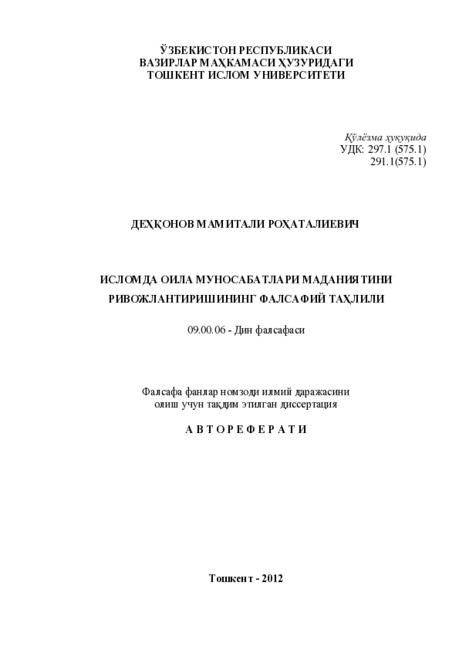
Subject of research: system of family relations, culture of family relations based on Islamic and National values, process of spiritual grousing of person in family.
Purpose of work: scientific-philosophical analyses of genesis, evolution and nowadays Culture of family relations in Islamic studying on the aspect of spiritual grousing, giving methodological recommendations and practice offers to grow spiritual level of society and person in Culture of family.
Methods of research: scientific methods such as analysis and synthesis, induction and deduction, historical and logical are used, the methods of dialectics, synergetic, hermeneutics.
The results obtained and their novelty: family institution, culture of family relations have been studied threw Religious Philosophy, role and importance of family on process of spiritual grousing of person and society on Islamic context have been studied, new methodological recommendations have been achieved.
Practical value: research results have practical importance on growing up the effect of spiritual-educational work with using Islamic moral value integrated in paint art, on ideological work against fundamentalism, religious extremism, immoral recidivism.
Degree of embed and economic effectivity: research results make opportunity using the integration processes between religious and (paint) art on the spiritual grousing of person more while, can be used on propaganda of religious and national values, were used on preparing of new study courses and program.
Field of application: research materials can be used in the process of educational system in preparing lectures, training-aids and programs on the subjects of "Philosophy of Religious", "Spiritual studies" "Religion", "National Idea" and other courses. -
 Problems of Indian philosophy in Abu-Reyhan Beruni’s outlook (historic-philosophical analysis)
Catalog of abstractsObjects of research: Problem of Indian Philosophical - conceptual approaches Abu - Rcyhan Bcruni to the philosophical Indian problems and to study the scientist’s contribution to Eastern philosophy.
Purpose of the work: to base philosophical-conceptual approaches to Abu-Reyhan Beruni’s outlook.
Methods of research: scientific observations, historical - logical, comparative, synthesis and analysis, generalization.
The results achived and their novelty: Disclosed a role of Beruni’s philosophical and systemic to historical, social and conceptual sources in forming of Indian philosophy. There were made and given practical recommendations in comparative analysis of ontological and gnoseological problems of Indian philosophy, as well as there were discussed social and ethic, religious and moral norms and ideas in development of Indian society.
Practical value: Scientific - theoretical considerations and practical recommendations expressed in this dissertation may be used in preparation and of educational books, methodical appliances, study programs and texts of lectures, as well as in the work in cultural centres.
Degree of embed and economic effictivity: the basic ideas of the dissertation have found the reflection in publications, performances at scientific-theoretical and practical conferences, have been used at carrying out in lectures and tutorial delivery with the students of the National University of Uzbekistan.
Field of application: results of the dissertation can be used in scientific researches in the system of the humanities, in pedagogical activity, at development of politics of formation national spirituality and education of youth. -

Subjects of reserch: Development of social and cultural life of society, moral-culture and philosophic analyze of its system and social dynamic.
Purpose of work: Philosophic analyze of system of the spiritual culture from the pour of view of definition of requirements and peculiarifily of socio- dynamics
Methods of reserch: The basis of the research consists of formation development systems and functions of moral-culture. That is objective, logical, comparison analyze.
The results obtained and their novelty: Discussion about categories of “culture” and “moral-culture” helps to understand uncertainties in cultural philosophy. Culture-material and moral culture, national and humanitarian culturemoral, moral-culture of independence are dialectical connected to each other and also they are social dynamic cases.Theoretical-philosophical ideas of the research may be used as theoretical base.
Practical value: the practical consequences of research may be used by social-pedagogical institutes which are deal in this sphere, moral-culture centers, The Moral (Spiritual) Center of Republic, TV and Radio, publishing houses.
Degree of embed and economic effictivity: main ideas of thesis are mode in scientific theoretical conferences, seminars, used in holding practical lesson with the students of faculty of philosophy in TNI of OS . And also with students of Tashkent Avtomobile and Road Construction Institute and in published works.
Fied of application: results of work can be used in HEL, academic lyceums, colleges in the process of studying of problems of education, teaching and forming it’s systems. -

Subjects of the inquiry: the analysis of social - spiritual aspects of death and immortality.
Aim of the inquiry: the philosophical analysis of scientific and religious ideas about essence of death and immortality and about features of display.
Methods of inquiry: objectivity, system, comparative analysis, analysis and synthesis, generalizations, historical, logic.
The results achieved and their novelty: In the dissertation: a) connection of concepts " thanatology ", "death", and "immortality", interrelation of their common and individual aspects; b) are given classification of evolution of sights on death and immortality; c) the reflection of death and immortality in the religious doctrines is investigated; d) the man’ attitude to death and immortality in his spiritual activity is opened; e) the importance of death and immortality in spiritual - serial growth of the person is proved.
Practical value: The approach of sudden death is registered by a sharp stop of ability to live of organism. It means, that after definition of death it is impossible to restore a vital sign and any accepted measures can not return the man to life.
Degree of embed and economic effectivity: The basic contents of the dissertation were used during realization seminar employment in a subject " Philosophical problems of a science " of Philosophical faculty in National Universite of Uzbekistan in institute of physical culture in subjects "Philosophy", and "Ethics". Conclusions and the conclusions have found the reflection in statements of the author at scientific republican and international conferences.
Sphere of usage: Scientifically and the practical results of research can life are used in study of philosophical problems of such subjects as typology, pathogens, nephrology, and also in social philosophy. -

Subjects of the inquiry: personality, life, Bakliauddin Nakshbandiy’s heritage (legacy), peculariries of practical adaption teachings of nakshbandiya studying.
Aim of the inquiry: study of the primary sources on the heritage and the philosophy of life of Bakhauddin Nakshbandiy, the practice of the teachings of nakshbandi, effective usage of this heritage and theoretical and practical recommendations.
Methods of inquiry: In studying the researches on sufizm sublects methods of scientific cognition are used, systematic development, scientific analysis, of history study (historism), logism (logical study), dialectiki, comparative valuing, systematization, philisophical generalisation and others.
The results achieved and their novelty: In this research for the first time the author studied on the basis of generalization of the researches, studied the life and teachings of Bakhauddin Nakshbandiy, their role in the development of social and philosophycal troughts (ideas); the influence of Yassavi studies, Kubravi studies in the formation of Nakshbandi and spiritual and moral roots of the teaching; the modem state and scientific level of the practical use of Nakshbandi heritage - legacy his philosophy of life and teachings, the beginning of social and political, governmental state activity of Bakhauddin Nakshbandiy; analysis of the principals (rashha) and Nakshbandi studies “in the soul the God, the work in hands” from philosophycal point of vileo the problems of the practical usage of Nakshbandi teachings and his system of social defence.
Practical value: The results of research give possibility of risht and adequntely present the place influence and importance of Nakshbandi in the development of social and philosophycal, religions and spiritual ideas of Turkestan. The essence of the idea of Kind heartedness and activity in the teachings of Nakshbandi, their significance in the rebirth- cevival of national treasures- valuables and their propagande also their usage in practice.
Degree of embed and economic effectivity: Untill the independence up today the essence of Nakshbandi teachings were took roots in social and political life spontaneously - mechanically, Thranks to the independence real possibilities are created of applying in life historical heritage- legacy and bucluding the teachings of Nakshbandi. The ideas of Nakshbandi teachings are the samples og hogh spirittuality and serve for the vaising the social activiry of the individuality.
Sphere of usage: The conclusions and the materials of the thesis could be used in writing the subsequent sections and chapters of a number of sciences, in the preparation of and in the developing and compiling textbooks handouts, in developing lectures and at practical lessons, at the lessons on spirituality. -

Objects of the inquiry: need of the society in spiritual values.
Aim of the inquiry: philosophical disclosing of the transition of Uzbekistan to market-oriented economy, establishing different forms of property, changes in the society system, require spiritual values of the society under the conditions of information inflow resulting in progress, essence, content and the structure of spiritual values as well as its system of formation.
Methods of the inquiry: objectivism, necessity and interlinks, concreteness, relativity and activity, responsibility of a subject, system analysis, historical and logical scientific methods. While analyzing the results of sociological survey, the Person’s criterion of conformity and formula of trustworthiness coefficient proposed by Student have been used.
The results achieved and their novelty: the place, essence, peculiar status of spiritual needs in the system of renewed society have been defined; the spiritual needs as an object of research have been studied for the first time in the conditions of independent development; the dialectical link of spiritual needs with the system of political, economical, and social demands in the progress of developing society has been considered; the philosophical analysis of spiritual needs as a necessary and enriched event in the development of society has been done; dialectics of social consciousness and spiritual needs have been studied; the necessary dialectic interlink of spiritual needs of the personality, society and the state has been highlighted; proceeding from conditions of independent Uzbekistan the role of spiritual needs has been studied.
Practical value: the conclusions, analyses, recommendations, achieved results of the research can be widely used by appropriate organizations, departments during global studies of spiritual needs of society as well as in designing the spiritual factors being formed in the society to be intended for the defense of interests of individuals and society.
Practical value: the conclusions, analyses, recommendations, achieved results of the research can be widely used by appropriate organizations, departments during global studies of spiritual needs of society as well as in designing the spiritual factors being formed in the society to be intended for the defense of interests of individuals and society.
Degree of embodiment and economic efficiency: the results obtained were reflected in scientific-methodical works published by the author, in the materials of international and republican scientific-practical conferences; they were used during the preparation of lectures on social disciplines.
Sphere of usage: the materials of the research can be used in delivering lectures, organizing the practical seminars on such disciplines as philosophy, study of culture, bases of spirituality, and political science. -

Subjects of research: philosophical and scientific creative works of al-Farabi in context of the modern spiritual culture.
Purpose of work: to reveal and to motivate the aesthetic ideas of al-Farabi’s the main component in modern spiritual life and as the most important means of aestheticism and humanism society.
Methods of research: The historical, logical and comparative analyses arc used in the work, directed to reveal the adequacy of aesthetic ideas of al-Farabi.
The results obtained and their novelty: the special analysis of the work’s ideas al-Farabi was realized from the position of the aesthetics theory; the difference of aesthetic ideas al-Farabi from Platon and Aristotcl is analyses on concrete sources; the general humanistic values of aesthetic ideas of al-Farabi arc determined; the al-Farabi views on aesthetic essence of the music arc examined in detail; the value of the aesthetics of al-Farabi for spiritual improvement of the personalities is proved.
Practical value: the results, obtained in study, promote to objective understanding and estimation of aesthetic ideas not only al-Farabi, but also medieval thinkcrs-pcripatetic in a whole. The deductions of dissertation can be used in making generalizing works on history of the aesthetics in Central Asia and Kazakhstan, as well as in process of the undertaking spiritual and aesthetic education of modern youth.
Degree of embed and economic effectivity: the results of the research arc important for conducting pedagogical and educational work, for reading lecture on the subjects: "Aesthetics", "Cultural study", "History of philosophy", "The Foundations Spirituality", "National Idea".
Field of application: the materials of dissertation can be used in the field of humanitarian sciences in preparing textbooks, scholastic and methodical curriculum on aesthetics, philosophy, music, ethics and spirituality. -

Маълумки, балоғат фанлари: илм баён, илми маъон, илми бадеънинг такомили натижасида мумтоз поэтикада илми сегона (илмлар учлиги: илми аруз, илми қофия, илми бадеъ) юзага келди. Илмлар учлигининг таркибий қисмларидан бири илми қофиянинг назарий асослари аввал араб адабиётида кейинчалик форс адабиётида пайдо бўлди. Форс адабиёти таъсирида туркий адабиётда ҳам қофия илмининг назарий асосларига бағишланган рисолалар яратилди. Мумтоз поэтиканинг назарий асосларига бағишланган араб, форс ва туркий тилдаги рисолаларнинг аксариятида бу уч илм яхлит ҳолда берилса ҳам, улар бир-бирининг таъсирида яратилган. Абулҳасан Али Сараҳсий Баҳромий (ваф. 1106), Шамсиддин Қайс Розий (XI аср охири – XIII асрнинг I ярми), Аҳмад Тарозий (XIV аср охири – XV аср бошлари), Абдураҳмон Жомий (1414–1492), Воҳид Табризий (XV) каби олимлар қофия илми хусусида махсус асарлар ёзган.
-

In this article, the pecuhanty of the art of interpretation is studied on the basis of the three sciences of "science segona". The art of writing is one of the arts that emerges on the basis of a combination of art, rhyme, and eloquence, and the article examines this type of art in the example of bytes. The study is based on Atoullah Hussein i's Badoyi us-sanoyi.
-

Abdurauf Fitrat zamonasining yirik olimi sifatida adabiyotshunoslikning barcha yo‘nalishlarida izlanishilar olib borgan. Fitrat matnshunos, manbashunos, tilshunos, lug‘atshunos, adabiyotshunos, nazariyotchi sifatida bir qancha ilmiy risola va maqolalar yaratdiki, bu ilmiy merosda aks etgan ilmiy xulosalarning aksariyati bugungi kun tadqiqotlari uchun asos vazifasini o‘tamoqda. Garchi oradan bir qancha vaqt o‘tgan bo‘lsa-da, olim tomonidan olib borilgan tadqiqotlar hali hanuz o‘z ilmiy ahamiyatini yo‘qotgan emas.
Abdurauf Fitrat garchi adabiyotshunoslikka oid qarashlarini maxsus tadqiqot yoki maqola shaklida yozmagan bo‘lsa-da, olimning bu boradagi ilmiy xulosalari adabiyot tarixida yashab, ijod etgan shoirlar ijodiyoti tahliliga bag‘ishlangan ilmiy maqolalarida, ularning manbalari va matniy tadqiqiga bag‘ishlangan ilmiy risola, majmualarida o‘z aksini topgan. Aslida Fitratning har bir yo‘nalishdagi ilmiy tadqiqotlari alohida tadqiqot uchun material bo‘la oladi. Fitratning tahrir va tahlil uslubi alohida tadqiqqa muhtoj. Olimning matnshunoslik va manbashunoslikdagi xizmatlari beqiyos, ularni bir butunlikda taqdim qilish adabiyotshunosligimiz oldidagi asosiy vazifalardan biridir.
Biz ushbu monografiyada Fitratning adabiyotshunoslikka oid qarashlarini tadqiq etishga imkon qadar harakat qildik, natijada bu boradagi izlanishimiz tugal bo‘la olmasligini angladik, tadqiq jarayonida olimning yangidan yangi tadqiqotlariga duch keldik. Bu esa adabiyotshunoslikda hali qilinajak vazifalar ko‘pligini ko‘rsatadi. Ushbu monografiyada Abdurauf Fitratning adabiyotshunoslikka oid qarashlari quyidagi yo‘nalishlar asosida taqdim qilindi:
- Olimning davrlashtirishga oid qarashlari;
- aruzshunos sifatidagi faoliyati;
- Fitratning manba bilan ishlash tamoyili;
- olimning lug‘atshunos sifatidagi faoliyati;
- adabiy tur va janrlarga oid munosabati ;
- badiiy asar uslubi masalasi;
- qofiyaga oid qarashlari;
- milliy she’r tizimi, tahlil, talqinlar;
- adabiy oqimlar borasidagiilmiy xulosalari;
- badiiyat masalasi;
- Fitrat tadqiotlarida xalq og‘zaki ijodi;
- qadimgi davr manbalari;
- Fitratning tasniflash tamoyili(“Eng eski turk adabiyoti namunalari” majmuasi asosida).
Umid qilamizki, qo‘lingizdagi monografiya Abdurauf Fitratning ilm yo‘lidagi, adabiyotshunoslik sohasidagi tadqiqotlari bilan tanishtirishga yordam beradi.
-
 Synergetic approach philosophical ideas «Avesta» (ontological and epistemological analysis).
Catalog of abstractsThe aim of the research consists of studying and analyzing ontological and gnosiological peculiarities of philosophical ideas in “Avesta”on the basis of synergetic phenomena.
Scientific novelty of the research consists of the followings:
It reveals the significance of such categories of synergetic methodology as systemacy, complexity, non-linearity, selforganization in researching Avesta in the light of ontology and epistimology;
The system of sources, in particular, the advantages of approaching to the problem from the point of view of the harmony between order and chaos, irreversibility of the development, and whether the system under research is open or closed, is justified with examples;
Scientific conclusions, suggestions, and recommendations on conceptual influence of philosophical ideas in Avesta to the development of modem philosophical views, its role in spiritual selforganization of humans, bringing up the children in the spirit of patriotism and humanity;
In “Avesta” gnosiological peculiarities of individual's spiritual understanding in the sequence of feeling, knowing, realizing and activity arc revealed. -
 HOZIRGI ZAMON SHARQ FALSAFASIDA INSON MUAMMOSIUshbu maqola hozirgi zamon Sharq falsafasida inson muammosini o‘rganishga bag‘ishlanadi. Maqolada Sharq falsafasining tarixiy va kontseptual asoslari, shuningdek, uning inson hayotiga, maqsadiga va axloqiy qarashlariga qanday ta’sir ko‘rsatganligi tahlil qilinadi. Hindiston, Xitoy va Fors falsafalaridagi asosiy yondashuvlar orqali insonning mavjudligi, ruhiy holati va maqsadlari muhokama qilinadi. Maqola, shuningdek, hozirgi zamon Sharq falsafasining ijtimoiy, siyosiy va madaniy o‘zgarishlarga qanday javob berayotganini, uning insonning ichki dunyosini va jamiyatdagi o‘rnini qanday tushunishini ko‘rsatadi. Hozirgi kunda Sharq falsafasining meditatsiya, yoga, mindfulness kabi amaliyotlar orqali insonning ruhiy muammolarini hal qilishdagi roli o‘rganiladi. Maqola, shu bilan birga, Sharqfalsafasining inson muammosiga bo‘lgan yondashuvlarini zamonaviy dunyo sharoitida qadriyatlar, ekologik va ijtimoiy adolatga oid masalalar bilan bog‘laydi
Pedagogy and psychology in the modern world: theoretical and practical research
