All articles - Biodiversity and conservation
-
 Reserve museums under an open sky as a method for preserving the historical and cultural heritage and tourism developmentArchitectural studies on the creation of a reserve museum allow for the simultaneous preservation of historical and cultural heritage and the development of tourism by placing the appropriate infrastructure for the fruitful work of archaeological scientists and active tourists visiting the archaeological site
Scientific research results in pandemic conditions (COVID-19) -
 A study of the biology of fruit tree pests in the botanical garden
Renaissance in the paradigm of innovation in education and technology in the XXI centuryЖемістер – жемірлер мен бізтұмсық қоңыздардың, сондай-ақ кейбір егеіштердің сүйікті дәмді қорегі болып табылады. Бұған қоса көбелектер (күйелер) шырынды жұмсағын, ал бізтұмсық қоңыздар мен сары егегіштер сүйекшелерін жақсы көреді. Жапырақ шипатқыш көбелегі айрықша иян келтіреді: жұлдызқұрт кезінде жаздың асында ол бүршіктер мен түйіндерді белсенді түрде жеп, өсімдіктің өнімділігін едәуір төмендетеді, сөйтіп бірте-бірте өнімділік пайызын минимумға апарады. Қанатты шыбын-шіркейдің жеке түрлері жұмыртқаларын тікелей жидек үстіне салып, өз ұрпағына қорек дайындайды.
-
 Хоrаzm vilоyаtidа аntrоpоgеn vоhа lаndshаftlаrini muхоfаzа qilishgа оid bа’zi mаsаlаlаrMaqolada Xorazm vohasining bir qismi hisoblangan Xorazm viloyati antropogen voha landshaftlarining ekologik sharoiti, jumladan hududning asosiy qismini egallagan su’goriladigan maydonlar tuproq qoplamiga salbiy ta’sir ko’rsatayotgan turli xil omillar sanab o’tilgan. Ushbu omillaming yuzaga kelish sabablari hamda murakkab ekologik vaziyatlarga yechimlar ko’rsatilib, taklif va tavsiyalar berilgan.
Новый Узбекистан: наука, образование и инновации -
 YANGI TUG’ILGAN CHAQALOQLARDA TUG’MA ZOTILJAMNINIG KLINIK VA LABORATOR XUSUSIYATLARIPnevmoniya - o'pkaga ta'sir qiladigan o'tkir respiratorli infektsiyaning bir shakli. Bu asosan bakterial etiologiyaning o'tkir yuqumli kasalligi bo'lib, o'pkaning nafas olish qismlarining intraalveolyar ekssudatsiya bilan shikastlanishi, yallig'lanish hujayralari tomonidan infiltratsiya va parenximaning ekssudat bilan singdirilishi, mahalliy inflammaning klinik va rentgenologik belgilarining mavjudligi bilan tavsiflanadi. boshqa sabablar bilan bog'liq emas.
Modern Science and Research -
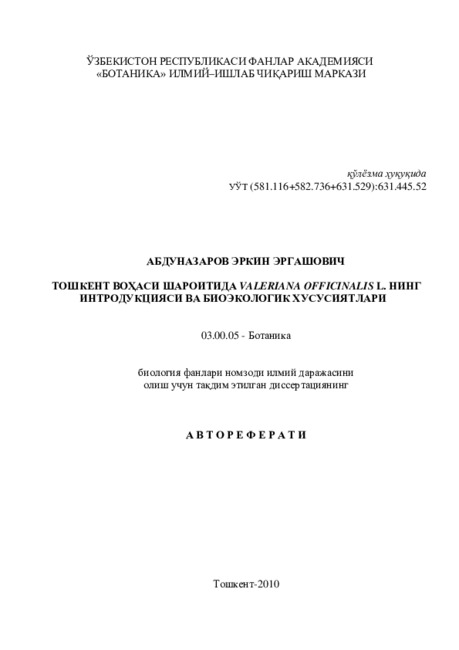 Introduction and biological particularities Valeriana officinalis L. in the conditions of Tashkent oasis
Catalog of abstractsSubject of research: Valeriana officinalis L. (Valerianaceae)-pcrcnnial plant.
Purpose of work: to study bioccological properties of V. officinalis and establishment of seedling areas in Tashkent oasis’s conditions.
Methods of research: laboratory and field experiments, phonological, morphological, bioccological, physiological, phytochemical, agrotechnical and statistical methods.
The results obtained and their novelty: for the first time V. officinalis in the conditions of Tashkent oasis, morphological and bioccological properties of medicinal V. officinalis compared to autumn and spring seedling periods have been studied. Rhythm of seasonal growth, biology of daily and seasonal flowering, potential and real seed productivities, as well as main indicators of water regime have been investigated. Phytochemical content of aerial and ground biomass of plants in both periods of seedling, assay of ether oils and isovalcriana acid in leaves and roots have been studied.
Practical value: bioecological properties have been studied V. officinalis in the conditions of Tashkent oasis and initial agrotechnical methods have been developed. Achieved results can be applied by pharms, which specialise in cultivation of medicinal plants, agricutural workers, forestries, educational-methodological processes in universities.
Degree of embed and economic effectivity: based on the investigation results, recommendations were offered to private enterprise “Zamona-Rano” (report from 22.05.2009 r.).
Field of application: introduction, biology, ecology, forestry, pharmaceutics, agriculture. -

Subjects of research: flora and vegetation of the Southwest Aralkum.
Purpose of work: studying of the flora and vegetation of the Southwest Aralkum and determining dynamic migration of plants of dried Seabed.
Methods of research: the floristic research was carried on the basis of classical methods on morphology, comparative floristic, vegetation route geobotanieal methods, classification according to K.Z. Zakirov, P.K. Zakirov (1978), the type of areas by G. Walter, V.Alehyn (1936), A.A. Grosgcym (1936), migration by V.D. Aleksandrova (1964).
The results obtained and their novelty: 135 species of vascular plants belong to 2 departments, 3 classes, 11 subclasses, 23 orders, 26 families and 72 genuses grown was determined for the first time on the Southwest Aralkum and the modem system of species was elaborated. Vegetation consists of 17 formations and 34 associations. New 3 formations and 6 associations were described for the first time. The dynamic of migration (plant movement) on dried seabed was elaborated.
Practical value: the researches of flora and vegetation of the Southwest Aralkum create an opportunity to use them in phytomclioration works and in fixing of mobile sand.
Degree of embed and economic effectivity: the modem system of the flora of the Southwest Aralkum is used for teaching at KSU named after Bcrdakh (Certificate № 01-21-01/367 from April, 22, 2009) and at NukusSPI named after Ajiniyaz (Certificate № 01-20-08/255 from April, 22, 2009). Recommendations on geobotanieal data were given to Bioccology Institution of K.K. ASc UzR (Certificate №7/03 from March, 23, 2009) for using it in phytomelioration works.
Field of application: botany: flora, systematic, geobotany and ecology. -
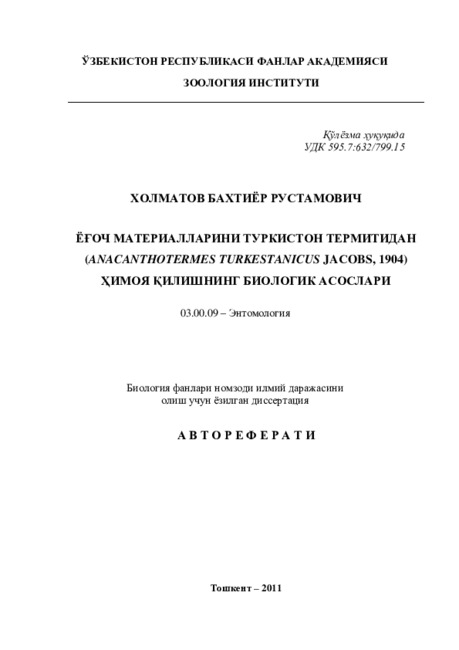 Biological basics of protection of wooden materials from damage caused by Turkestan termite (Anacanthotermes turkestanicus Jaсobs, 1904)
Catalog of abstractsSubjects of research: the Turkestan termite, plants, chemical control.
Purpose of work: development of scientific bases of protection of wooden materials from damages caused by the Turkestan termite (Anacanthotermes turkestanicus).
Methods of research: common entomological and statistical methods were applied in the dissertation.
The results obtained and their novelty: specimens of 31 plant species from the flora of Uzbekistan were for the first time studied in the work. By the inflicted damage, these plants arc divided into four groups. Methods of protection of wood types, which arc not persistent to termite-inflicted damages, were developed using the impregnation of them with chemical preparations.
Practical value: types of wood, which can be used in the construction of residential houses and other buildings in places of termite habitats and persistent to their attack, arc identified. The use of a highly effective local preparation Scptor-2 is of importance for the protection of historic monuments from termite attacks.
Degree of embed and economic effectivity: a local preparation Scptor-2 was applied for the protection of the mosque Khasan-Khusan in Nurata district of Navoi province, where it showed a high economic effect.
Field of application: the Ministry of culture and sport of the Republic of Uzbekistan, Department for culture and sports of Navoi province. The obtained results arc also used in the construction of residential houses, public buildings and historic monuments for their protection of termites in areas of the intensive distribution of termites. -
 Microorganisms of the rhizosphere of salt-resistant plants of the Aral Sea region
Catalog of abstractsSubject of the research: soils of deserted zones and rhizosphere of desert plants, halo- and thermotolerant bacteria
Purpose of work: the main aim was search for and isolation of halotolerant and thermotolerant bacteria from salty soils of the Southern Aral Sea region, determination of their diversity and establishment of the collection of extremophilic bacteria with valuable biotechnological features.
Methods of the research: classical microbiological (Yegorov, 1995; Gusev and Mineeva, 2006; Dobrovol’skaya, Skvotsova and Lysak, 1989) and biochemical (Yesikova et al., 2002; Yegorov, 2003) methods.
The results achieved and their novelty: for the first time, the distribution of halo- and thermotolerant microorganisms was studied in details for specific conditions of the Ustyurt Plateau, deserts Aralkum and Karakum, which are characterized by extreme natural conditions. The frequency of their appearance in different substrates (soil, plants’ rhizosphere and so on) was determined as well.
1152 strains of halo- and thermotolerant bacteria were isolated from salty and alkali soils of the Southern Aral Sea region (Central Karakum, Aralkum and the Ustyurt Plateau). 27 extremophilic bacteria and producers Bacillus circulans 600, B. circulans 608, B. muciloginosis 334, strain Halobacteriaceae 301 were selected and identified. Optimal medium was determined and cultivation conditions were optimized for growth and development of extremophiles. Their resistance to antibiotics was studied and antagonistic activity of selected bacteria was determined. It was revealed that metabolites of extremophilic bacteria increase seeds’ germination and growth of desert plants.
For the first time, the collection of indigenous halo- and thermotolerant bacteria isolated from natural zones with extreme environmental factors was established.
Practical value: for the first time in Uzbekistan the detailed microbiological work on study of microbial diversity of desert and deserted biotopes of the Southern Aral Sea region and on isolation and study of halo- and thermotolerant bacteria characteristic for that region was conducted. Obtained theoretical data may be included in to study books recommended for the educational institutions.
Degree of embed and economic efficiency: isolated extremophilic bacteria may be applied for rehabilitation of grazing areas of the desert regions of Uzbekistan.
Field of application: fundamental and applied microbiology, biotechnology, agriculture. -
 A characteristic of the morpho-biological and membrane activity of the venom of Сoluber and Еlaphe
Catalog of abstractsSubjects of research: snakes: Coluber ravergieri, Coluber tyria and Elaphe dione.
Purpose of work: the purpose of this work is the study of the ecological-biological characteristic of the Coluber and Elaphe snakes, comparative studies of the membrane activity of the secrets a venomous snakes of Uzbekistan, the characteristic of their biological traits.
Methods of research: zoological, ecological, physiological, biophysical and biochemical methods of work arc applied in this work.
The results obtained and their novelty: several snake species of the Coluber and Elaphe , in relation to their daily and seasonal activity, conditions of habitation and breeding in biogcoccnoses of Uzbekistan have been characterized.
During the study of the effect of crude venoms of Coluber and Elaphe snakes on biological membranes, neurotoxic components, which arc the basis for further studies on the isolation of individually pure neurotoxins, were revealed.
Practical value: the rcsultes which were taken arc very important to produce the way of keeping biodiffcrcnce types of snekes being learnt in Uzbekistan.
It is possible to use zootoxin effect of the animals under study on the functional parameters of membranes create prerequisites for the use of these venoms and target tools in studies in the sphere of mcmbranology and zootoxicology.
Degree of embed and economic effectivity: results obtained during the study of venoms and components are a prerequisite for the search of new pharmacological preparations in the system of public health for the treatment of various cardio-vascular diseases, including the prophylaxis of blood coagulation.
Field of application: nature conservation, public health, physiology, biophysics. -
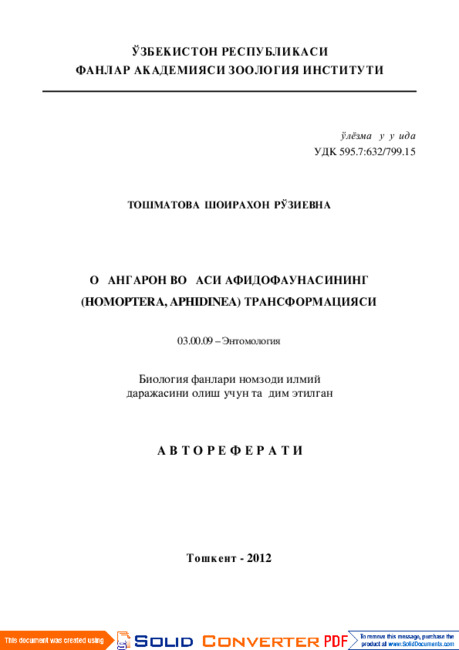
Subject of research: Aphidofauna in Akhangaran valley.
Purpose of work: Research on Aphidofaunas in Akhangaran valley and the basic directions of transformation.
Methods of research: cntomologic, aphidologic, ccologic and statistical methods were applied in the dissertation.
The results obtained and their novelty: Aphidofauna (Homoptera, Aphidinea) in Akhangaran valley were for the first time studied in the work. There have been revealed 227 types and 3 subspecies belonging to 75 sorts and 6 families, these 3 types (Brachyunguis azimovi Akhmedov et Tashmatova, 2005, Brachyunguis uzbekistanicus Akhmedov et Tashmatova, 2004, Dysaphis ertoshica Akhmedov et Tashmatova, 2005, Acyrthosiphon scariolae kuraminensis Akhmedov et Tashmatova, 2005) and one of the subspecies (Acyrthosiphon scariolae kuraminensis Akhmedov et Tashmatova 2005) has been identified as a new to science, Myzus langei Borner, 1933 as a newfound fauna of the Central Asia, Uroleucon jaceae reticulatum (Hille Ris Lambers, 1939) as a newfound aphidofauna of Uzbekistan and for the first time 147 kinds and a subspecies have been registered in the valley. On typological structure aphidocomplcxes arc subdivided into 27 associations, 15 formations and 10 types. The basic directions of transformation of aphidofaunas and aphidocomplcxes, the linear connection between kinds of indicators and sub indicators in aphidocomlcxes have been proved. The conditions of primary and reformed aphidocomlcx, infringements of borders of ecological niches under the influence of the anthropogenous pressure have been identified. On the basis of coefficient of association reliability of infringement and division of ecological niches has been proved. The criterion of predictability of contamination and assessment of desertification has been expressed.
Practical value: the practical aspect of the dissertation is to use obtained results for solution of the problem of prognostication of mass reproduction of widespread and harmful kinds, to develop science-based measures of struggle against them, to determine the basic directions of transformation of entomofaunas, to predict and value conditions of desertification, and preservations of biological varieties.
Degree of embed and economic effectivity: results of research work arc applied for forecasting course of ctnomofauna transformation and conditions of desertification.
Field of application: nature and wildlife preservation, protection of plants, formation and scientific researches. -
Subjects of research: wild flora of vascular plants of Zaamin state reserve.
Purpose of work: inventcrization and creation of vascular plants conspectus of Zaamin state reserve and it’s analysis.
Methods of research: classical floristical, morphological, geographical methods of plant taxonomy.
The results obtained and their novelty: a new modem conspectus of vascular plants of Zaamin state reserve consists of 1192 species from 530 genera and 103 families. Vegetation consists of 5 dominating floroccnotypes. Investigated area belongs to Kuhistan district of Mountainous Central Asiatic province. 2 new species have been found within this area and newly described {Astragalus russanovii, Allium levichevil).
Practical value: The results will be used in creation of modem list for the Flora of Uzbekistan. Conspectus was given to scientific department of Zaamin state reserve and nowadays is used for scientific reports and protection issues. The list of flora, it’s endemic species as well rare and endangeres species can be used for lectures and practical studies on flora, taxonomy and geography of vascular plants in unviersities.
Degree of embed and economic effectivity: developed recommendations were accepted by Zaamin State reserve belonging to Department of reserves, national parks and hunting areas of Major department of Forestry of Ministry of agriculture and Water resources (statement №011, by 14.10.2011) and department of biology and it’s methods of teaching of Dzhizak State Educational Institute (statement №4 by 13.10.2011).
Field of application: floristics, plant taxonomy, botanical geography and nature protection. -
 Problems and prospects of breeding, genetics and biotechnology in Uzbekistan rabbitThis article presents information on the problems and prospects of rabbit breeding in the development of rabbit breeding in Uzbekistan. The article describes the use of genetic modification and biotechnology in the development of rabbit breeding based on the laws of heredity and variability, as well as in improving the useful economic qualities of rabbits and creating new breeds of rabbits for the rabbit breeding industry.
Перспективы кролиководства: проблемы и решения -
 Growth and development of hybrid rabbits from crossing california and local rabbitsThe article describes the growth dynamics of hybrid rabbits obtained from the crossing of Californian and local breeds. The average age of 44 female rabbits was 210 days. The average weight of the experimental rabbits was 4173.3±17.1 g. compared to the age of 180 days, it was 239.7g more (R>0.99).
Перспективы кролиководства: проблемы и решения -
 This article provides information on the scientific research conducted on rabbit breeding at the Center for Selection and Genetics, the development of rabbit breeding by breed and color. The article describes the patterns of heredity and variability of rabbits, their use in improving the color of skin and wool, which is one of the useful economic qualities of rabbits when creating new breeds of rabbits. The main characteristics of the genotypes and phenotypes of rabbits used in the experiments of the Center for Selection and Genetics of Rabbit Breeding are given.
 -
 The biodamages, caused by birds in Uzbekistan and improvement of eco-technolojical methods of their prevention
Catalog of abstractsThe urgency and relevance of the theme of the dissertation. Present time Global environmental change creates complicated situations all over the world. One of them is biodamages of anthropogenic landscapes by birds. For example, «currently horticultural sector of Australia has 300 billion dollars of the USA damage, African countries grain and grapes production loose approximately 87.3 billion. Dollars, every year it takes part about 4000 accidents between birds and aircrafts»1. In this regards the determination of birds caused damages, its prevention and working out the methods of its control are very important task.
After getting independence in our country it is payed solid attention to the modernization of economic sector, specially to the main branch of agroindustrial sector such as agricultural production. The were some achievements on the basis of effective methods of prevention of biodamages caused by birds and development of safe means of protection, including protection of the agricultural yield from various biodamages, as biodamage caused by birds and also in this regard the improvement of the development of harmless recourses, improve the results of their efficiency.
Currently, the increase of the area of anthropogenic landscapes and dependence of birds from these landscapes caused to increase of several problems of biodamages in different sectors of agriculture, economy and aviation transport. In this regards, in the conditions of anthropogenic landscapes, the scope of damage caused by birds in grain production, horticulture, viticulture, as well as honey bee production and their ecological technological nature, prototype and analog quantities determination, development of the ways to reduce of damage, as well as regulation of birds behavior near airports to limit accidence between birds and aviation transport by application of ecological technological systems and its modernization is very significant problem. Implementation of the results of investigation for modernization of ecological technological methods for prevention birds caused damages can be explained as following: determination of ecological causes of attraction of birds to the important production sectors (agriculture, aviation, industry, power lines etc) by application of single and differential approach; determination of the nature of highest culmination points of birds acoustic and repellent signaling systems; synthesis of acoustic repellent imitators and development of mechanisms of inter-specific effects; approval of complexes of biotechnological systems to prevent birds caused damages; development and implementation into practice of preventive ecological and technological methods on the basis of behavior and sensory organs features of birds.
The research of this dissertation in a certain degree serves to the solution of tasks stipulated in the decree № PF-3709 of January 9, 2006 «Programs for economic modernization in horticulture and grape production» of the President of the Republic of Uzbekistan, and the decree № PF-2460 of December 29, 2015 of the President of the Republic Uzbekistan «Programs for modernization and development of agriculture» and the decree №294 of October 24, 2014 «On measures for further development of civil aviation and strengthening the material-technical base of the National Airline «Uzbekistan havo Yullari» and also in other legal documents adopted in this area.
The aims of the research is an investigation of birds caused biodamages and modernization of ecological technological methods of their prevention.
Scientific novelty of the research are in the follows:
it was determined the level and dynamics of biodamage caused by birds at the croplands and in the territories of aeroports;
populations of Sturnidae and biological importance of acoustic signals in the interspecies acoustic communicative relationship as well as phylogenetic origin of acoustic repellent signals were determined;
on the basis of bioacoustic investigation it was first time described an alarm repellent signals of common bee-eater (Merops apiaster L.) and blue-cheeked bee eater (Merops superciliosus L.) the highest part - existence of alarming signals was identified and application of this signals in honey bee farms was scientifically proved;
it was first time investigated interspecific influence of an alarm signals of my-lady's-belt to other species of birds;
dangerous migration of birds alongside of territories of aeroports and eco-technological methods of forecast of situation were developped;
first time in the Uzbekistan condition, it was created an acoustic-reppelent complex of birds on the basis of birds sensors features.
CONCLUSIONS
On the basis of the conducted research on doctoral dissertation on the theme «The biodamages, caused by birds in Uzbekistan and improvement of eco-technological methods of their prevention» the following conclusions were presented:
1. It was proved that the nature of biological damages caused by birds to different sectors of economy is linked with ecologic pliability, ethology, migration, and sinanthropy as well.
2. It was assessed the biological damage caused by birds to different croplands which were as followings: grape yards 17-19%, horticulture 31-86%, wheat 7,6-8,3%, rice 2,1-3,4%, sorgum 33-42%, breeding plots, seed testing plots 45-100%. All it depends from seasonal birds’ life.
3. About 30 species of birds are nesting in the airports and nearby areas. These causes to accidents with aircrafts which has a seasonal shape, where spring and autumn were higher which can be explained by migration, nesting and other factors.
4. Altruistic behavior of birds provided a stable population structure, and imprinting was linked directly with biological damages caused by birds.
5. The alarm signal of Indian starling and other predator birds with interspecific effect to birds, spectral-time sound closeness, principal similarity, simplicity of modular frequency, mechanisms of signal origination can be explained by simple signal initiation.
6. Rapid analyses of spectral timely structure of acoustic repellent signals shows that acoustic repellent signals of sparrows have common phylogenetic root and allows to determine an imitone.
7. It was in first time determined of the higher culmination point-alarm signal of bee-eater and with using this signals it was possible to protect a honey bee from biological damage.
8. In principal object it is necessary to apply biotechnological systems together with ecological approach and by imitation real-dangerous situation to enhance efficiency of application of repellent system.
9. It was developed special methodology to prevent biodamages caused by birds and complex installation «Optical repellent installation» and «Optical acoustic repellent complex» strategy to limit harmful effect of birds were recommended.
10. In case of combined use of «Optic repellent installation» and «Optical acoustic repellent complex» there were possible to reduce a damage up to 80% in airports, civil buildings 90-95%, power line system 100%, horticulture and viticulture 80%, honey bee form 70% and grain croplands 60% higher efficiency. -
 Adaptive features of vegetative organs species of the genus Climacoptera Botsch. (Chenopodiaceae) in connection with halophytic
Catalog of abstractsTopicality and relevance of the theme of the dissertation. Today soil salinization on a world scale is one of the global problems that cause great damage to the sectors of economy. «Currently, nearly 10% of the land in the world consists of saline soils that have a negative impact on 75 countries, located in arid zones»1.
In the years of independence, large-scale reforms have been carried out in the agricultural sector of our country with a special focus on native reclamation of land and improvement of soil fertility. On the basis of the realized policy measures certain results were reached in this area, including the use of effective methods of fighting against soil salinization, introduction of water-saving technology, the definition of resistant species of plants and development of new kinds for saline soils, as well as improving their efficiency in phytomcliorative events.
In the world, definition of halophytic plants sustainable on saline soils and their use for reclamation of saline lands, including the definition of halomorphic and xeromorphic traits in species of Climacortera Botsch. family of Chenopodiaceae Vent., prevailing among halophytic plants are of great importance, which makes it possible to understand the resistance of plants to salinity and adaptive features of halophytes. One of the current problems is determining the adaptive features of vegetative organs to the salinity on the basis of morphological and anatomical traits of species Climacoprtera and introducing them into practice. Determination of morphological and anatomical adaptive features of vegetative organs of Climacoprtera species to salinity and their use in practice arc as follows: clarification of the origin, taxonomy and ecology of Climacoprtera species, studying the structural features and development of vegetative organs under the influence of drought and salinity using morphological and anatomical methods, evaluation of specificity and functionality of adaptive anatomical features, definition of sustainable indicators of species on the basis of genotypic and phenotypic characteristics, reasoning of halotolcrance and haloresistance, determination of the economic value of the plant, proving the possibility of halophytes using for rehabilitation of saline and marginal lands.
The present dissertation research to a certain extent serves for the fulfilment of the tasks stipulated in the Presidential Decree No. PD-3932 of the Republic of Uzbekistan «About measures to fundamentally improve the system of land reclamation» of 29 October 2007, the Resolution No.PR-1958 «About measures to rationally use the water resources and improve the ameliorative state of irrigated lands in the years 2013-2017» of 19 April 2013, as well as other normative and legal documents adopted in this area.
The aim of the research is determining the adaptive features of morphogenesis, ontogenesis and the anatomical structure of vegetative organs of Climacoptera Botsch. (Chenopodiaceae) species in connection with halophytic.
Scientific novelty of the research is as follows:
for the first time, we identified species-specific characteristics in ontogenesis and morphogenesis of species of the genus Climacoptera due to the different conditions of habitat;
we identified different types of mesophyll in assimilating organs, a combination of xero- and halomorphic signs in connection with environment, as well as the reaction of a leaf in the altered habitat;
we characterized the formation of the structure of species of the genus Climacoptera axial organs and determined the direction of structure development: in the stem - from the primary beam to abnormal policambial, radically - from diarchy to secondary thickening;
we proved the structural significance of primary and secondary protection in the cortex of the central cylinder in different environmental conditions;
we determined the presence of alkaloids in aboveground mass and nutritional value of species of the genus Climacoptera-,
we revealed the general direction of the adaptatiogenesis of species of the genus Climacoptera: rosette growth form, mesobasitonic and basitonic branching, succulence of leaf with a kranz-structurc, policambiality of stem and root;
we determined the prevalence of halomorphic signs of species growing in Mirzachul on soils with sulphate-chloride type of salinity, xcromorphic signs - the species growing in Ustyurt with chloride-sulphatc type of salinization;
we recommended the use of species of the genus Climacoptera in phytomclioration of degraded pastures on the basis of halomorphic and xcromorphic signs, as well as their feeding qualities.
CONCLUSIONS
On the basis of the carried research on the theme of the doctoral dissertation «Adaptive features of vegetative organs of species of the genus Climacoptera Botsch. (Chenopodiaceae) in connection with halophytic» the following conclusions are presented:
1. It was determined that in the latent period of ontogenesis, the fruit of Climacoptera species are protected by the sclerificd perianth in varying degrees; the pericarp and spermoderm arc reduced, the embryo is coiled with green cotyledons and polynomial buds. Seedling rosette, compact habitus and the length of all the stages of ontogeny reflects the adaptation of species to the current arid conditions.
2. In assimilating organs of Climacoptera species, different types of mesophyll were identified: dorsiventral type in cotyledons, Climacoptera-\ypc and krantz-ventral-dorsal type in the leaf. Leaf adaptation to arid conditions is ensured by a high degree of succulence and the presence of kranz-cells with C4-typc of photosynthesis.
3. The difference of the structural features of the leaf of Climacoptera species from Salsola genus due to discontinuity of chlorenchyma layer, 3 conductive beams in the central plane, and remoteness of peripheral beams from kranz-plates was confirmed.
4. It was found that the primary stem bark combines parenchyma and collenchyma in different volumes due to habitat conditions: the predominance of sclcrification of cortex in species growing in Ustyurt, parenchymatous - in species growing in Mirzachul and Kyzylkum.
5. A relationship was established between the anatomical structure of stem and moisture keeping ability in arid climate in Climacoptera species, which is evidenced by the primary sheaf structure of stem and secondary abnormal policambial sclcrcnchymatous beam-type thickening.
6. The increase of the conductive ability and protection of Climacoptera species root from drying in arid conditions arc due to a spiral root system, homozygosis, diarch primary xylem, poly cambial secondary thickening, early phellogcn laying, spiral beam-type thickening, greater parcnchimatization and less scelirification (C. ferganica, C. affinis).
7. Low content of alkaloids in various aboveground mass was found, and the nutritional value of Climacoptera species was determined.
8. The main direction of the adaptive process of Climacoptera species arc: rosette growth form, mesobasitonic and basitonic branching, succulence of kranz-structurc leaf, policambial stem and root, sclcrification and parcnchimatisation of perianth.
9. In relation to halomorphic and xcromorphic signs of vegetative organs, structural and adaptive groups of species were identified: halomorphic, xcromorphic and halo-xcromorphic reflecting the environment and belonging to different types of habitat.
10. On the basis of halomorphic and xcromorphic signs and taking into account the content of biochemical fodder indicators of aboveground mass, the perspective species of Climacoptera arc recommended for use in phytomclioration of degraded pastures. -
 Production agrotechnology of obtaining high yields of agricultural crops under a year-round use of takyr soils with transition to meadow soil type
Catalog of abstractsThe urgency and relevance of the dissertation topic. According to United Nations projection a world population has to exceed 9 billion people in 2050. Statistical information shows that every 15 years the world population increases for one billion. Doubling population of Central Asia since 1980 increased demand for agricultural products, which escalated demand for land and water resources. Since all water and land resources are fully allocated between land and water users there are limited number of ways to increase food crop production in the region and one of them is a year-round use of agricultural lands with obtaining two to three crop yields in a year.
The aim of this research work is the development of the optimal agrotechnologies for the efficient use of land resources and obtaining two to three crops yields in a year in conditions of irrigated takyr soils with transition to meadow soil type the southern regions of Uzbekistan.
The tasks of research:
to investigate the impact of crops production as a main crop and summer crop on soil agrophysical properties by continuous a year round use of lands under the conditions of takyr-like soils with transition to meadow soil type.
to study the effect of a year round use of irrigated land on level and mineralization of groundwater, dynamics of the seasonal salt accumulation in soil depending on irrigation scheduling.
to determine the optimal sowing dates, seed rate, plant density of crops are grown as a main and summer crops and after winter wheat harvest.
to set the optimal soil moisture, irrigation dates and amount, irrigation scheduling and scheme, duration of irrigation as well as seasonal irrigation rates of crops grown as a main and summer crops, and after winter wheat harvest.
to define the impact of irrigation scheduling and fertilizer application on the growth, development, yield accumulation and yield as w'ell as weight of one cotton boll. 1000-grain and a head of cabbage and onions.
to determine the seasonal water consumption and application volume for the production of 100 kg of crops yields for all crops and varieties studied.
The object of the research work are takyr-like soils with transition to meadow soil type, upland cotton varieties Bukhara-102, Bukhara-6, Bukhara-8, fine-staple cotton variety Termez-49, winter wheat variety Chillaki, winter barley variety Bolgyali, maize varieties Nart and Uzbekistan-306AMV, headed cabbage varieties Sharkia and Uzbekistan-133 varieties, onion varieties Sumbula and Zafar.
The subject of the study are agrochemical, agrophysical soil properties, groundwater level and salinity dynamics, coefficient of seasonal accumulation of soil salinity, crop irrigation scheduling and fertilization, growth, development and yield of crops.
Scientific novelty of the research work is as follows:
highly productive agrotechnological elements for cultivating upland and fine-staple cotton varieties, winter w'heat, barley, maize, late cabbage, onions as a result of more efficient use of land resources w'ere developed for the first time in conditions of takyr-like soils with transition to meadow soil type in the southern regions of the country;
the influence of a year-round use of takyr soils on their agrophysical properties, the groundwater level and salinity and the seasonal soils salinity accumulation dynamics were determined;
the indicators of optimal soil moisture, irrigation timing and duration, seasonal water consumption and application volume for the production of 100 kg of crops yields under the continuous land use were determined;
in conditions of the selected soils, the influence of the optimal irrigation scheduling and fertilizers application on crop growth and development, yield, weight of one cotton ball, 1000-grain and a head of cabbage and onions were shown.
