All articles - Art
-

Reasearch objects: Khamza’s archive in the State Literature museum named after Alisher Navoiy on Academy of Science of the Republic of Uzbekistan, the poet’s manuscripts in fund of the institute of Oriental studies named after Abu Raykhan Bcruniy on Academy of Science of the Republic of Uzbekistan and in Kakand Literature museum named after Gafur Gulom.
Purpose of work: Implementation of textual-comparative analysis of the manuscript “Devony Nikhoniy” and collection “Ethnic poems for ethnic songs”, and solving theoretical-methodological problems of study of Khamza’s poetry
Method of research: historical-comparative
Research results and their novelty:
The problem of sources of Khamza’s poetry and its textual analysis is investigated as an object of investigation for the first time;
Theoretical-methodological principles of study of Khamza’s poetry are defined on basis of the analysis of investigations on poet’s oeuvre;
On basis of textual analysis of poems in “Devony Nikhoniy” texts of lyric works of poet were restored in accordance with the original; As a result of comparative analysis of the original and edited versions of poems on social-political theme from “Ethnic poems for ethnic songs” collection there were defined textual differences, and made theoretical generalizations.
Practical meaning: the materials of research can be used in higher educational institutions, especially, in practical lessons on subjects like “Uzbek literature in the period of National revive”, “Uzbek literature” at philological faculties, in creation of manuals and tutorials for bachelors and masters on subjects like “Textual study”, “History of literary source study and textual study”, “Stages of development of Uzbek written text”.
Results of use: According to results of research there were given scientific lectures and 10 scientific articles were published.
Field of use: literary criticism, literary source study and textual study. -
 Traditional Embroidery of Southern Regions of Uzbekistan in the 20th – beginning of the 21st century
Catalog of abstractsSubjects of research: Traditional embroidery and Oq-cnli carpets of the Southern regions of Uzbekistan - Surkhandarya and Kashkadarya districts.
Purpose of work: To identify local specifics of the traditional embroidery in Surkhandarya and Kashkadarya in 20th -21st centuries, to describe the process of preservation and revival of the traditional hand made embroidery in the region.
Methods of research: Comparative Art analysis is made in order to identify the local features of the Regional Embroidery on the basis of studying and classification of the embroidery items using the materials from the Scientific Expeditions and Museum Collections.
The results obtained and their novelty: Main centres of the Embroidery were allocated as well as masters and graphic artists of the region concerned. The role and the significance of the Traditional Embroidery nowadays and the local traditions of the regions concerned were closely examined. There were technological art peculiarities studied on the basis of analysis of the embroidery in each centre of the village, typical for the local traditions. The important emphasis was paid to the studying of Compositional techniques and the type of decorations used in the centres of traditional embroidery on the basis of comparative analysis of the traditional embroidery of Surkhandarya and Kashkadarya districts and their significance within the Embroidery Schools throughout Uzbekistan.
Practical value: Results of the present studies could be used as the Guidance Book for the Graphic and Embroidery Artists. This research carries a very important practical meaning for reserving and reviving traditions of embroidery in Southern Regions of Uzbekistan.
Degree of embed and Economic affectivity: Main clauses of the dissertation arc similar to the ones used in 12 scientific publications and magazine editions.
Field of application: Materials from this Research work might be used for the lectures on the History of Applied Arts of Uzbekistan and also in publishing textbooks or manuals on the subjects concerned. These materials would be beneficial for the State Grants in Scientific Art Researches. -

Subjects of research: Artistic representation of the season cycle in the art of musical composition in a broad historical (from the end of the 18th to the early 21st century) and geographical range. Pieces selected for the analysis include classical specimens of world musical culture of the past and works by modern (Uzbek and foreign) composers, most of which are studied in this perspective for the first time.
Purpose of work: Using the art of composition as example, to demonstrate various interpretations of “the seasons” theme in its historical evolution, to identify its different renditions in the works of contemporary Uzbekistan composers and to prove their connection with national artistic traditions.
Methods of research: The object of research determined the application of his-torico-typological, comparative (synchronic and diachronic) and holistic methods of research.
The results obtained and their novelty: This is the first attempt to trace the historical evolution of various interpretations of the seasons theme in the musical art. The results of the study and some theoretical theses of the dissertation can contribute to the construction of scientific theory of artistic content as a complex evolving system reflecting stages in the development of creative thinking.
Practical value: is in broadening the knowledge about the art of composers representing different national schools of composition, who developed the seasons theme, and in contributing to the enrichment of musicology with studies of new contemporary music pieces.
Degree of embed and economic effectiveness: The dissertation materials have been used in the lecture course titled “History of World Music” taught at the department of music history and criticism of the State Conservatory of Uzbekistan.
Field of application: The key theses of the study could be used in academic work and pedagogical practice, in lectures on the history of world music and musical styles, and the history of Uzbek music, as well as in cultural studies. The outputs allow enhancing the standards and effectiveness of education activities performed by lecturers-musicologists. -
Subjects of the research : the rock drawings revealed by the author, and also occurring in the publications, devoted to discovered in the mountain gorges of the Central Asia petroglyphs.
Such statement of an issue has been put forward in the seventies of XX century. Therefore the author addresses to petroglyphs of the Central - Asian region (Uzbekistan, Kazakhstan, Tadjikistan, Kyrghyzstan), and in searches of analogues - Caucasus, Mongolia, Altai and other areas that enables to establish the general tendencies of development of rock paintings, as well as its thematic direstion.
Aim of the research: studying of compositional, reconstructive and art -technological regularities of rock drawings of the Central Asia, revealing their contents, the form, means of expressiveness, and also a place and value in culture of an antiquity. According to the purpose of the dissertation tasks have been assigned.
Method of research: is based on the analysis and generalization of literary sources and results of natural works; complex interpretation of each scientific valued phenomenon; classifications of drawings, graphic reconstruction of all details in modern graphic style.
The results achieved and their novelty: For the first time on the basis of complex research of petroglyphs of the Central Asia classification of rock drawings taking into account general composition, research area, a degree of richness of stages characters and their arrangement on a natural background of one or another form arc conducted. For the first time graphic reconstruction of rock drawings with their contents revealing and preservation of the general composition in space is carried out.
Practical value: Practical value of work is in the opportunity of using of the analytical materials, conclusions and graphic reconstruction as translation into modern plastic language for: a) creation of scientific studies on a history of Uzbekistan, and also methodical manuals for students of High Schools on preparation of experts in the field of the fine arts, architecture and design; 6) restoration of the ethnographic data, including ancient household ceremonies, rituals; в) formation of inhabited complexes.
Degree of embed and economic effectivity: Basis of work and researched issues arc revealed in a number of publications in scientific magazines, in proceedings and other editions.
Field of application: a history of art, ethnography, cultural science, art criticism, museum and archival science. -
 Rindona meaning (related to the nature of may (wine) and freedom of mind) and the nature of lyric character in Uzbek classic poetry
Catalog of abstractsThe object of research work is to identify factors for the emergence of rindona type poems, to reveal important features, historical development and important characteristics of a lyric image-rind.
Scientific novelty of the research work is as follows:
revealed development factors of rindona poems, system of images, ideological and literary features, scales of description, methods of expression and the nature of lyric character;
proved religious mythological concepts of Eastern people for the emergence of rindona poetry, their social lifestyle, customs and traditions, their essence and aesthetic features;
researched the impact of khamriyat from ancient Arabian and Persian-tajik literature on classic Uzbek literature;
brought evidences from literary unique features of poems, bayts (a coupled lines) and misras (lines) created by the first half of XV century in Eastern literature, in particular, in Turkish poetry;
proved the potentials of expression in Uzbek literature, symbols' and characters' inner worlds, histrorical and literary features;
revealed social reasons for the scale of popularity of rindona poems in Uzbek classic literature and aesthetic criteria;
proved lyric character's outlook, the main idea of rindona poems of spiritual-educational picture, poetic nature, inter-connections with literary representation principles;
studied the similar and distinguishing features of rindona poems created in the first half of XII-XV century's Uzbek literature, the problems of lyric character. -
 The conception of revival the gardening art of Temurids in the landscape architecture of Uzbekistan
Catalog of abstractsThe purpose of research work: is improvement and development of effective ways of revival of traditional landscape gardening art of the period of Temurids in modem landscape architecture of Uzbekistan.
Scientific novelty of the research work is as follows:
genesis of ancient gardens of Egypt, Mesopotamia, Persia, Greece, Rome, China, Sogda, Medieval Japan, Mauritian Spain for the purpose of identification of the techniques and receptions of a garden planning which have influenced on formation of the "Chor-bag" gardens and "Hiaban" boulevards of the 14th - 15th centuries is scientifically proved;
the interference fact, common and distinctive features of landscape gardening art of the Middle East, Central Asia, Mauritian Spain and Northern India of the period of the 14th-17th centuries are elicited;
types, parameters and methods of creation of 38 "Chor-bag" gardens and "Hiaban" boulevards (of above -mentioned regions) are investigated and specified in the summary table;
for the purpose of identification of features of architectural, vegetable and water compositions, the graphic-analytical analysis of miniatures, illustrating the gardens of XV-XVI cc. period is held;
scientific - theoretical bases (types and parameters, modularity of creation of gardens, water devices, selection of plants, architecture of garden objects) and design offers on revival "Chor-bags" and "Hiabans" of Temurids in landscape architecture of Uzbekistan are formulated. -
The aim of the research work. The aim of the study is to describe the centuries-old musical and creative traditions and to determine their place and significance in the Uzbek contemporary music culture.
The scientific novelty of the research work:
identified religious, mythological, folk-ritual and other cultural layers of historical background of art yallachi;
revealed semantics, and trichord the basis of intonational dictionary of women's musical creativity;
installed create typical artistic images in art yllachi on the basis of receipt of modal cells and different rhythmic formulas;
on the basis of examples and actual materials the reflection of the Uzbek woman's rich spiritual world, peculiarities of her creative thinking and sensitive attitude in the art of yallachi is proved;
the significance of the yalla genre in the formation and development of the Uzbek pop song. -
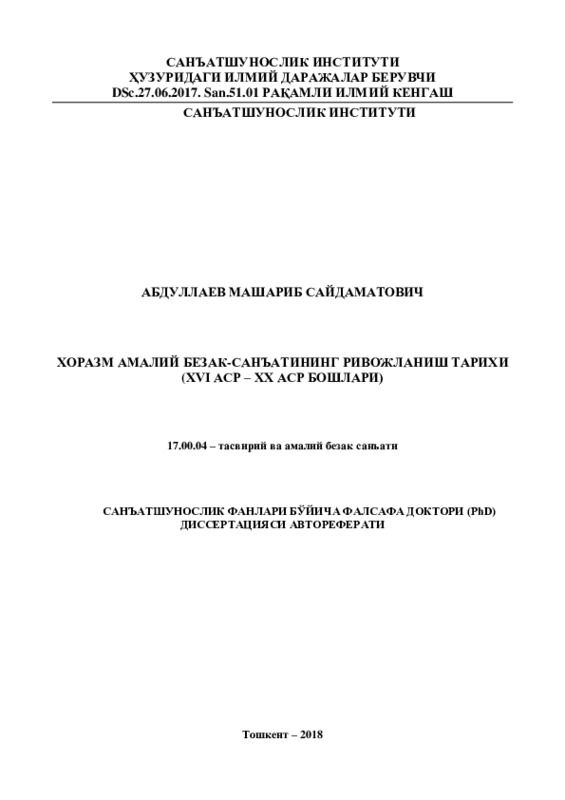 History of development of the applied arts of Khorezm (16th – beginning of 20th centuries)
Catalog of abstractsThe aim of the research work is to define the main stages of development and artistic features of applied arts of Khorezm in the period of Khiva khanate.
The scientific novelty of the research work:
Retraced the evolutionary development, historical and artistic features of the applied arts of Khorezm in the 16th - beginning of the 20th centuries;
Determined the negative or positive aspects of influence of socio-political processes on the development of art crafts on the basis of the analysis of art history;
Revealed the local features of applied arts of Khorezm;
Worked out the classification of the ornamental system of the artistic craft of Khorezm;
Discovered the interrelation between architecture and applied arts;
Elaborated number of recommendations on the restoration of disappeared species and artistic-technological methods of Khorczmian applied arts.
