All articles - Water Resources
-
 Geographic determinism and the impact of water resources on the model of development of the Central Asian territory
Актуальные проблемы обучения социально-гуманитарных наук в медицинском образованииIn this article, the author focusses on such an important issue as the fertility of the land and its impact on social reality. The issues of land degradation in Central Asia are considered.
-
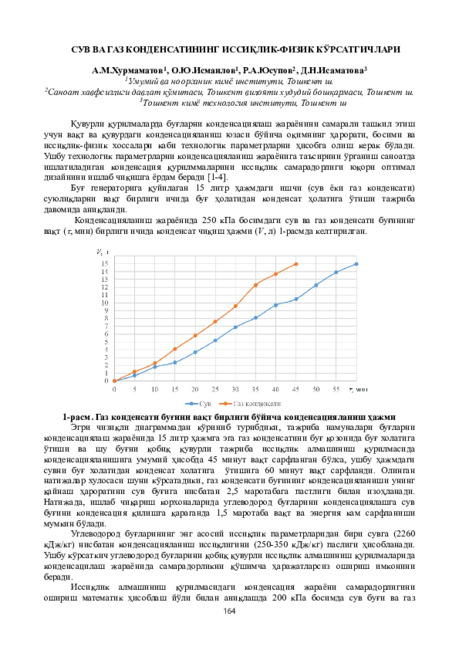
Қувурли қурилмаларда буғларни конденсациялаш жараёнини самарали ташкил этиш учун вақт ва қувурдаги конденсацияланиш юзаси бўйича оқимнинг ҳарорати, босими ва иссиқлик-физик хоссалари каби технологик параметрларни ҳисобга олиш керак бўлади. Ушбу технологик параметрларни конденсацияланиш жараёнига таъсирини ўрганиш саноатда ишлатиладиган конденсация қурилммаларини иссиқлик самарадорлиги юқори оптимал дизайнини ишлаб чиқишга ёрдам беради [1-4]
-
 O’zbekistondagi suv taqchilligining iqtisodiyotga ta’siri
Green chemistry and sustainable developmentInson o'zining butun mavjudligi davomida dunyo haqida to'liq tasavvurga ega bo'lmasdan va faqat bir lahzalik vazifalarni yaratishga intilgan , xoh u oziq-ovqat ishlab chiqarish, xoh atom elektr stantsiyasini qurish bo'lsin. Har safar yaratilish va rivojlanish vektori inson o'z ehtiyojlariga muvofiq foydalanadigan atrof-muhitga qaratilgan. Hozirgi vaqtda insoniyatning muammolari, resurslarning ortib borayotgan qismini ishlab chiqarishni rivojlantirishga emas, balki atrof-muhitni saqlashga sarflash kerakligi bilan keskinlashmoqda. Aks holda, uning ifloslanishi yalpi milliy mahsulotning o'sishini sekinlashtira boshlaydi va uni oshirishga investitsiyalar samaradorligi pasayadi. Biroq, hozirgacha faqat dunyodagi eng boy davlatlar atrof-muhitni saqlash bo'yicha keng ko'lamli dasturlarni amalga oshirishga qodir. Eng kambag'al davlatlar bunga qurbi yetmaydi.
-
The article discusses the impact of the environmental situation in the Aral Sea region on the health of the population. The data of the analysis of environmental factors are presented.
-
Back in the early 70s, while studying at a secondary school, at geography lessons, we, with bated breath, listened with admiration to a teacher who talked about the Aral Sea, which was famous for its richest natural reserves. The incomparable isolation and diversity of the Aral Sea did not leave anyone indifferent. Having entered the 21st century, the Republic of Uzbekistan, like other states, has faced the most serious problems in the field of the environment. Among them, one of the most global is the environmental problem. Life in the chemical world has become more comfortable for a person, but at the same time it has acquired additional elements of risk to his life and health. The whole planet has long been concerned about the problem of the Aral Sea, the restoration of the vital water resource of which is directed by the minds of scientists and practitioners around the world. The Aral Sea was the fourth largest lake in the world, and the Aral Sea zone was considered a prosperous and biologically rich natural environment.
-
 Agrar sohada suv resurslaridan foydalanishning ahamiyati va uni soliqqa tortish xususiyatlari
Новый Узбекистан: наука, образование и инновацииMaqola agrar sohada suv resurslaridan foydalanish ahamiyati va uni soliqqa tortish masalalariga bag‘ishlangan bo‘lib, unda bugungi suv resiurslarining tanqisligi, suvdan foydalanishni tartibga solish, ayrim rivojlangan mamlakatlarda suvdan foydalanish va uni soliqqa tortish, shuningdek sohani rivjlantirish bo‘yicha tavsiyalar keltirilgan.
-
The urgency and relevance of the theme of dissertation. The freshwater resources of the globe form only 3 percent of the total planetary volume of water. Nowadays, a shortage of these resources becomes a global problem. It is known that 87 percent of the world's freshwater is used in agriculture.
A suite of measures aiming at effective use of irrigation water, improving its quality, applying water-saving methods, techniques and technologies of irrigation of the agricultural crops is carried out in Uzbekistan. Furrow irrigation is widely used in the country. Under a furrow irrigation, the losses of the irrigation tail-end water, actual physical evapotranspiration and infiltration can be reduced by the implementation of water-saving techniques and technologies. In this regard, it is important to implement a technology of irrigation of cotton and other crops by introducing furrows mulched with black polyethylene film and wheat straws.
Application of mulch with opaque and water-proof materials leads to increased concentration of carbon dioxide and hydrocarbon gases, improved respiration of soil macro- and microorganisms and accelerated biochemical processes in the soil root zone of cotton. These soil gases accelerate the formation of mineral and organic acids, which in turn arc involved in the conversion of sparingly soluble phosphates into the readily soluble forms in the soil. As a result, the losses of gaseous forms of nitrogen fertilizers arc reduced, efficiency of nitrogen nutrition of plants is increased, which results in increased yields of cotton and other crops. Irrigation of cotton with mulched furrow helps reducing actual physical evapotranspiration and erosion of topsoil layer, hence contributing to water saving and increasing raw cotton yields.
To adopt a water-saving technology of cotton in accordance with the Decree of the President of Uzbekistan №PP-1958 "On additional measures to ensure further improvement of ameliorative conditions of irrigated areas and rational water resources use for the period of 2013-2017" in 19 April 2013, the decree of Cabinet of Ministers DCM №261 "On measures to improve the formation and implementation of ameliorative land reclamation programs" adopted in November 28, 2008 and a technology of cotton irrigation through furrows mulched with black polyethylene film should be implemented. Elaboration of this technology is the basis for this dissertation.
The aim of research is optimization of water consumption of cotton with application of water- and resource-saving technologies using mulched furrows and developing practical recommendations for crop production.
Scientific novelty of the research is as follows:
Methods of accurate and rapid determination of soil moisture using modem measuring instruments (neutron moisture meter, tensiometer) and under cotton irrigation through the furrows mulched using black polyethylene film and winter wheat straws were developed for the first time;
Saving of irrigation water and fuel was identified for the first time, high cotton yields of good quality cultivated under irrigation along the furrows mulched with black polyethylene film and winter wheat straws were obtained on the fields planted with the cotton variety Navruz in typical sierozem soils and An-Bayaut-2 on salt-affected gray meadow soils;
The advantages of soil mulching, which will reduce the actual physical evapotranspiration, improve water-physical soil properties, hence favoring an intensive growth and development of the above-ground parts of the cotton plants, were determined;
A positive effect of soil mulching on soil temperature, the gaseous soil composition and its distribution in the soil profile, quantity of useful groups of soil microorganisms were estimated for the first time;
A mathematical model describing the dependence of carbon dioxide emissions from the soil surface of cotton fields from the quantity of macro- and micro-organisms, soil density and moisture, was developed for the first time;
An adaptation of theoretically justified methodology of estimation of irrigation norms and water consumption of cotton (FAO-56 methodology) in various soil and climatic conditions (typical sierozem soils, gray meadow soils, width of row spacing, duration of growing season), irrigation technologies (irrigation with water supply into each furrow and alternate furrow), the degree of mulching (bare soil, mulching of 50% of cotton plantation) were done.
An effect of the cotton irrigation technology with mulched furrows on the economic efficiency of cotton cultivation was identified.
CONCLUSIONS
1. In order to achieve water saving during the cultivation of cotton in conditions of irrigation water shortage and global climate change, to ensure a uniform distribution of the soil moisture along the entire length of the furrows, increase the irrigation efficiency, prevent the fertile topsoil layer and nutrients from irrigational erosion, and save fuel and lubricants, it is appropriate to implement the water- and resource-saving irrigation technologies through the introduction of furrows mulched with black polyethylene film.
2. In conditions of the typical sierozem soils of the Tashkent province, at the beginning of the growing season, the average humus contents in the 0-30 cm soil layer were 0.770%, total nitrogen 0.076% and phosphorus 0.113%, while in the 0-50 cm soil layer, these values were 0.672, 0.066 and 0.100%, respectively. In conditions of the gray-meadow soils of the Syrdarya province, these values in the soil layers of 0-30 and 0-50 cm were 1.131-0.955% of average humus contents, 0.131-0.094% of the total nitrogen and 0.132-0.104% of phosphorus. Evaluation of the nutrient contents of the soils in the research sites showed that these soils belong to the low fertility category.
3. Assessment of the sol bulk density in typical sierozem soils at the end of the growth season in the 0-30 and 0-50 cm layers indicated that these values increased by 0.03-0.02 g cm'3. In conditions of the gray-meadow soils, at the end of the growing season the bulk density in the 0-30 cm in the treatment of the conventional irrigation increased by 0.05 g cm'3, while in the treatment of irrigation into the furrows mulched with black polyethylene film and straw, the bulk density increased by 0.02-0.03 g cm'3. Lesser soil compaction in the treatment of irrigation into the mulched furrows took place due to the reduced row cultivations, conducting them during the optimal dates and water applications for irrigation by the optimal norms.
4. Analyses of the meteorological observations in the "Akkavak" station for the past 89 years showed an increase of the average annual air temperature by 1 °C, of the average annual precipitation from 450 to 600 mm (by 150 mm), relative humidity from 53 to 68% (15%), decrease of the deficit of potential evaporation by 250 mm (27.0%) for the period of April-September, and by 187 mm (26.0%) for the period of May-August, of potential evaporation by 18.5 cm (1850 m3 ha'1) or by 17.8%.
5. In conditions of the typical sierozem soils with high slope of the land surface in the Tashkent province, water saving under irrigation of cotton of the Navruz variety through furrows mulched with polyethylene film estimated by the FAO-56 methodology was 847 m3 ha’1 or 22%, while the actual water saving was 1361 m3 ha’1 or 34% (on average 1104 m3 ha’1 or 28%). Irrigation through the furrows mulched with straw, the estimated water saving was 893 m3 ha’1 or 23 %, while the actual water saving was 1350 m3 ha’1 or 35% (on average 457 mJ ha'1 or 29 %).
The most efficient water-saving technology of the water application in the old irrigated gray-meadow soils of the Syrdarya region was the treatment with irrigation of cotton of the AN Bayaut-2 variety through the 90 cm row spacings mulched with polyethylene black film, where the estimated water saving amounted to 652 m3 ha'1 or 43.2%, while the actual saving was 600 m3 ha’1 or 37.4% (on average 626 m3 ha’1 or 23.8%).
Therefore, application of mulching the furrows with the black polyethylene film appears efficient in the topographically flat areas of the Syrdarya province with the slopes of 0.002-0.003, while in the cotton growing areas of the Tashkent province with the slope of 0.01 the efficiency of the application of surface mulching with black polyethylene film increased by 12% and with wheat straws by 5.2%.
6. During the experiments, the irrigation rates into the furrows mulched with black plastic film and wheat straw were reduced compared to the rates of the conventional furrow irrigation. In conditions of the typical sierozem soils under mulching with black plastic fdm and straw and the soil moisture regime of 70-70-60% FC, the irrigation rates were on average lower by 184 m3 ha’1 (4.2%), 160 mJ ha’1 (3.6%), 1066 m3 ha'1 (27.9%) and 1108 m3 ha'1 (29.0%) compared to the moisture regime of 65-65-60%. Saving of the irrigation water in the treatments with application of mulching and soil moisture regime of 65-65-60% amounted to 556 m ha’1 or 12.7%, while with the soil moisture regime of 70-70-60% to 582 m3 ha'1 or 13.2% compared to conventional furrow irrigation.
In the treatments with water application into the furrows mulched at the top with black polyethylene fdm and bottom with straw and 50-50-30 cm of the soil layers the irrigation rates in the 5th and 6th treatments averaged 2858 m3 ha'1, water saving was 1004-1040 m3 ha’1 under irrigation into the conventional furrows and 350-402 m3 ha’1 under water application into the furrows mulched at the top with black polyethylene fdm and bottom with straw.
In conditions of the typical sierozem soils and irrigation into the conventional furrows the achieved water saving was 2220 m3 ha’1 or 25.1%, whereas in the treatments of irrigation into the furrows mulched with black polyethylene fdm the water saving was 1182 nF ha'1 or 24.3%, in the treatment with irrigation into the alternate furrows the saving was 551 m3 ha'1 or 20.4% and 540 m3 ha'1 or 19.9%, respectively. Similar pattern was observed in the experiments conducted in the gray-meadow soils of the Syrdarya province.
7. Physical evaporation of soil moisture was 733, 717 and 680 m3 ha'1 higher in the treatments of irrigation into each furrow (treatments 1,2,3,) than in the treatments with irrigation into alternate furrows (treatments 4,5,6). These values under conventional furrow irrigation were 1690 and 955 nf ha’1, whereas in the treatments with furrow mulching with fdm the rates were 1592 and 765 nf ha'1 and with straw 1344 and 664 m3 ha’1, respectively.
8. The highest amount of soil microorganisms (85.6-207.8 mil. efu/g) in the cotton rhizosphere was observed in the treatments of the furrows mulched with polyethylene film . Thus, black plastic cover enables the formation of favorable air, water, temperature and nutrient regimes for the development of the soil microorganisms.
9. Analysis of the CO2 concentration dynamics in the soil air during the growing season of cotton showed that the highest rates of CO2 gas emissions (0.87 %) were observed under the furrows mulched with black polyethylene film and water application into the alternate furrows. Obviously, mulching the furrows with black polyethylene film and applying water into the alternate furrows helps creating optimal aeration conditions in the rhizosphere of cotton, respiration of living organisms, plant root system and useful soil microorganisms is increased, which in turn leads to increased concentrations of CO2 in the soil.
10. In the treatments 3, 4 and 7, 8 under water application regime of 65-65-60% and 70-70-60% from field water capacity, the high crop growth rates, development and accumulation of fruit elements were achieved. In September, the average number of bolls was 9.8-10.2 and 10.3-11.0 and the bolls opening amounted to 45.9-50.0 and 52.4-58.2%, respectively.
The advantage of irrigation into the furrows mulched with black polyethylene film over the conventional furrow irrigations into each furrow, into the furrows mulched with straw as well as into the alternate furrows was clearly established in this research: the average number of cotton bolls was 9.2-14.5, including 3.6-8.0 opened bolls or 39.1-55.0%.
11. The ratios of physical moisture evaporation and transpiration of cotton under the conventional furrow irrigation methods of 34:66 and 30:70 corresponds to the values observed under traditional cultivation practices. However, irrigation into the mulched furrows changes this ratio substantially to 4.4:95.6 in favor of transpiration, especially in the treatments with a full coverage of the soil surface with black plastic film. In this treatment, physical evaporation is reduced by 1515 m3 ha'1 or 89.6% compared to the control treatment.
12. In conditions of the typical sierozem soils under the irrigation regimes of 65-65-60% and 70-70-60% from field water capacity, the highest crop yields were obtained in the treatments of irrigation into the furrows mulched with black polyethylene film or straw, in which the cotton yield increased by 4.9-6.8 and 6.1-8.1 c ha'1 compared to the conventional irrigation methods. All treatments with the irrigation regimes of 70-70-60% from field water capacity prevailed over the treatments with the irrigation regimes of 65-65-60% from field capacity with yield increase of 0.6-3.5 c ha'1.
The highest yields of the field experiments in the typical sierozem soils were obtained in the treatments with the furrow tops mulched with black polyethylene film and bottoms mulched with straw (treatments 5-6), in which yield increase was 4.7-6.7 c ha'1 compared to the treatments with conventional furrow irrigation (treatments 1-2) and with irrigation into the furrows with open tops and bottoms mulched with straw (treatments 3-4).
The highest yields were achieved in both soil and climatic conditions in typical sierozem and sierozem-meadow soils with application of mulching with black plastic film and straw and with irrigations into each furrow and alternate furrows, in which the yields were increased by 3.2-7.0 and 2.2-2.5 c ha'1 compared to the yields obtained with conventional irrigation. In the treatments with irrigation into each furrow yield was increased by 2.8-3.6 and 2.8-3.5 c ha'1 compared to the alternate furrow irrigation.
13. The highest yields and the profitability of cotton were observed in the typical sierozem soils in the treatments of irrigation into each furrow (1-3) and alternate furrow (4-6). Maximal yield performance was obtained under irrigation into the furrows mulched with black polyethylene film (47.1 and 55.8%), followed by the treatments with irrigations into the furrows mulched with wheat straw (42.8-50.9 %) and the control treatments with the conventional irrigation methods (30.4 and 33.2 %).
Similar patterns were achieved in the experiments conducted in the sierozem-meadow soils of the Syrdarya province, where the highest yields were obtained in the treatments with irrigation into each furrow, but profitability was lower than in the all treatments of the conventional furrows, the furrows mulched with film and straw and irrigation into the alternate furrows (40.1, 49.5, 43.4% and 48.1; 57.2; 53.7%, respectively).
Based on the results of the research, the following recommendations arc suggested:
14. In conditions of the typical sierozem soils and slightly saline sierozemmeadow soils of the sulfate type, with irrigation into the alternate furrows and during cotton growth season, it is recommended to apply the irrigation rates in the amount of 450-500 m3 ha'1 for medium- and heavy-textured typical sierozem soils and 350 - 400 m3 ha'1 for the light- and medium-textured sierozem-meadow soils.
15. Mulching of furrows with crop residues of 1.5-2.0 t ha'1, left after of winter wheat harvest in the first and second decade of June showed the high efficiency in the cotton growing farms.
16. It is recommended to apply irrigation through mulched furrow with black polyethylene film during the budding stage of cotton, under the formation of true 6-8 leaves: in the row spacing of 90 cm wide along the back-wheel lines of the three-wheel tractor, in the row spacing of 60 cm wide along the inter-wheel spaces. The film with a thickness of 10-12 micrometers should be 10 cm wider than the row spacing. -
 Upgrading of the operation and methods of the hydraulic calculation of the system of biological treatment of sewages
Catalog of abstractsSubjects of research: domestic wastewater, biological wastewater treatment system.
Purpose of work: to reveal hydrodynamic features of the biological treatment system, upgrading the designs and increasing an efficiency of the work of the secondary clarifier treatment systems.
Methods of research: Methods of the study received in hydraulics and hydrobiology.
The results obtained and their novelty: Developed and approved mathematical model of the hydrodynamic mode of biological treatment of domestic wastewater from treatment plant.
Practical value: Obtained mathematical dependencies allow in determining of hydraulic parameters of biological treatment, developed design promotes for increasing an efficiency of the work of secondary clarifier.
Degree of embed and economic effectivity: Results of the work have been presented of the Groups in realization projects of ADB, executing a project reconstruction of treatment plant in Karshi city
Field of application: Water communal economy branches, waste water cleaning objects and environment safety organizations. -
 The regularities of the formation of Industrial iodine waters of Uzbekistan and the prospects for their use
Catalog of abstractsSubject of research: water-bearing complexes of mesozoic-cenozoic sediments of artesian basins in Uzbekistan.
Purpose of work: studying the regularities of the formation of industrial iodine waters of Uzbekistan, the scientific substantiation of hydromineral raw materials, development of technological schemes for extraction of iodine from underground industrial waters.
Method of research: the complex analysis of geological and hydrogeological, hydrogeochemical researches, the history of regional development in mesozoic and cenozoic, studying the regularities of formation of industrial iodine waters, an estimation of probable reserves, development of technology for extraction of iodine.
The results obtained and their novelty: the regularities of formation and distribution of industrial iodine waters of Uzbekistan, identified high concentrations of iodine in the groundwater between the structural zones of deep synclinal basins (Umid) and marginal parts of the intermountain valleys of Fergana Artesian Basin (Chust-Pap). The technological scheme of extraction of iodine is developed. Established a pilot plant for extraction of iodine. The patents on the method of extracting iodine, the installation for the extraction of iodine and an industrial design setting are received. Perspective deposits for the organization of industrial production of iodine are revealed, calculated and approved by the FS condition and stock SRC Republic of Uzbekistan.
Practical value: the perspective deposits of industrial iodine waters are proved, proved the association of elevated concentrations of iodine to the areas of gas and gas condensate deposits and deep faults. The regularities of the formation of industrial iodine waters are revealed. The technological scheme of production of iodine from underground and associated waters, increases economic efficiency and environmental safety in mining.
Degree of embed and economic effectivity: the results of the researches used in the mapping of mineral, thermal and industrial waters in Central Asia and the maps of industrial waters in Uzbekistan. Developed a technological systems are successfully implemented and have passed a pilot tests. The results obtained are introduced into the educational process in conducting studies on the geological faculty of National University of Uzbekistan.
Field of application: oil&gas and iodine-extracting industry of the Republic of Uzbekistan, the Education System. -

Subjects of research: a fibre Nitron waste, highly hydrolyzed poly electrolyte, glycerine, gossypol pitches, the salted sand, flocculant RS-2-3, structure forming agent MS-1.
The work purpose: Development of technology of reception of new kinds of highly hydrolyzed poly electrolytes on the basis of a fibre Nitron waste, modified by three-nuclear alcohol - glycerine and an oil fat industry waste the gossypol pitch, studying of their colloid-chemical properties and research of possibilities of areas of practical application.
Research methods: colloid-chemical, physical and chemical, IR-spectroscopy, microscopic and other methods of the analysis.
The results obtained and their novelty: for the first time the new technology of reception of VGPA on the basis of OPVN with high degree of hydrolysis in severe constraints and also its modified derivatives is developed: glycerine - a reagent of PS-2-3 condensation and gossypol pitch - thermal salt-resisting modified structure forming agent MS-1; it is established, that the polymers obtained do possess flocculating and structure forming properties and can be applied as regulators of colloid-chemical properties of industrial disperse systems.
The practical importance: the way of a condensation of concentrates of precious metals using structure forming structure forming flocculant PS-2-3 and a method of chemical fastening of the salted sand using structure forming agent MS-1 is developed.
Degree of embed and economic effectivity: Reagent PS-2-3 has passed trial and industrial tests in quality of flocculant for a condensation of foamy floating concentrates containing precious metals, on Angrensky GEF of Open Society «Almalyk GMK» and is introduced in manufacture with economic benefit of 300 million soums a year. Complex use of MS-1 together with wood sawdust has provided prevention of erosion of sand and improvement of ecological conditions at the drained bottom of Aral sea. Fastening of the salted sand with complex additive MS-1 with the wood sawdust there has passed skilled-field tests with positive results at coast of Kazahdarya of drained bottom of Aral sea and is recommended for introduction.
Field of application: the condensation of concentrates of precious metals at mountain-metallurgical industry as well as fastening of the salted sands at the drained bottom of Aral sea and its region. -
 Improvement the Method of Water Distribution among Agricultural Crops under Market Conditions Management (case-study of associations of water consumers)
Catalog of abstractsSubjects of research: Associations of water consumers “Sayram Suvi” in Kuyichirchik region of Tashkent Province.
Purpose of work: To improve of the water distribution planning method using economic-mathematical models of operative water division between agricultural crops considering economic aspects of managing in the conditions of deficiency of water resources.
Methods of research: At carrying out of researches has been used the theory and methods of calculation the correlation of yield from irrigating norms, methods of mathematical modeling, methods of planned water using, methods of the economic analysis of agricultural production, methods of statistical data processing, working out of a database and program modules, decisions of problems of water distribution between cultures.
The results obtained and their novelty:
More exactly method of a compiling of scheduling the water using plan considering an irrigation regime and economic efficiency mode of the agricultural plants in the conditions of deficiency of water resources has been developed for operative water use in associations of water consumers and farms; mathematical models, algorithms and a program complex of the decision of problems of modeling the operative water distribution between agricultural crops has been developed; dependences of crops on irrigating norm for various agricultural crops and their optimum irrigating norms in the conditions of Kuyichirchik region of the Tashkent province have been established.
Practical value: Use of the developed actions will give the chance to develop scientific researches in the field of water savings on the irrigated earths in farms.
Use of the developed techniques and program modules will allow farmers to have an opportunity with high degree of reliability to divide irrigating water between agricultural crops.
Degree of embed and economic effectivity: Results of scientific researches of dissertational thesis were applied in association of water consumers “Sayram Suvi» and it served farms with economic efficiency of 671 thousand in sum/hectares in a year.
Field of application: Associations of water consumers, farmers and dehkans. -
 Hydroecological condition and fishery potential of Arnasay Lake System and Mejdurechye Wwater Rreservoir
Catalog of abstractsSubjects of research: Amasay Lake System (ALS) on the middle reach of river Syrdarya, Mejdurechye Wwater Rreservoir (MWR) on the lower reach of Amudarya River, phytoplankton, fishes.
Purpose of work: development of comparative evaluation of hydro ecological condition and fisheries potential in the large polytypic water bodies on the base of detailed investigations of hydrophysical, hydrochemical, hydrobiological, ecotoxicological and fisheries indicators using ecosystem approach, as well as creation of the computerized database with main fisheries ecosystems indicators.
Methods of research: hydrobiological, hydrochemical, ecotoxicological, icthyological, hydrobiological, geoinformation methods of research.
The results obtained and their novelty: conducted detailed researches using ecosystem approach some particularities of dynamics of a hydrochemical regime and hydrochemical processes were established for the first time. Features of qualitative, quantitative and bioproduction parameters changes of hydrobionts under influence of natural and anthropogenous changes of environmental conditions of hydroecosystems of ALS and MWR were revealed. The bioecological and toxicological characteristics of modem commercial fish fauna is given and the conditions negatively influencing existence and fate of fish populations are clarified. On the basis of the obtained actual results significant improvement of ecotoxicological situation in investigated hydroecosystems is discovered. For the first time the ecohydrologycal data base, with application of program ArcView GIS_3.2 on the basis of own and literature data is developed, which provides possibility to evaluate modem ecosystem conditions.
Practical value: the received results of researches can be used for drawing up -conclusions about the condition of bioresources and ecosystems as a whole with the purpose of acceptance of optimum decisions in regulation and optimization of sustainable use and increase in bioproductivity.
Degree of embed and economic cffectivity: developed «Ecohydrologycal data Base » is given to the State biological control Agency at The state Committee on Nature Protection, Center of fish culture development at the Ministry of agriculture and water resources, and biology-soil science faculty of National University of Uzbekistan for practical application.
Field of application: wildlife management, fisheries, the higher and special educational institutions. -
Subject of research: the lakes of wetland Sudochje, Vest Karatcrcn, Muynak and Sarbass, the Aydaro-Amasaj system lakes, the lakes of Khorezm oblast, the lake Sarakamish in Fergana.
Purpose of work: to learn the present-day characteristics of zooplankton into plain lakes, those have transform drainage due to economical activity.
Methods of research: to include laboratory and field tools of hydrobiology analyses of zooplankton; physicochemical methods tj learn of water living conditions.
The results obtained and their novelty: has been carried out the inventory data of zooplankton species into lakes of Uzbekistan that includes a literary and native data; has been observed a seasonal and long-term succession and the quantitative dynamic of zooplankton into lakes of different depth, salinity; has been study the index of biodiversity, index of biomass distribution and other structural characteristics of zooplankton community.
Practical value: zooplankton data examined with fauna and biocenology perspective could be use for the prediction a species structure and quantity of zooplankton; to appear opportunity to modification of dominant zooplankton species for the community for improvement of food base into water bodies for fisheries importance.
Degree of embed and economic effectively: obtained results were used by development (substantiation) projects studied of potential productivity of reservoirs.
Field of application: practical and sanitary hydrobiology, ecological monitoring. -
Subjects of the inquiry: holoccnc sediments in the basin Chirchik.
Aim of the inquiry: To establish the characteristics of spatial-temporal structure of the geomagnetic field through the holoccnc palcomagnctic study of sections of the river basin Chirchik and drafting magnetostratigraphy scheme of Holoccnc sediments in the region
Methods of inquiry: magnetostratigraphy holoccnc on the basis of integrated field and laboratory palcomagnctic studies.
The results achieved and their novelty: For the first time the continental deposits of the holoccnc basin Chirchik by magnetostratigraphy studies modeled the structure of the geomagnetic field of the Holocene, the scheme magnetostratigraphy subdivision and correlation of the studied sections and the correlation magnetostratigraphy scheme. Age characteristics of short-term deviations of the holocene dates the gcomorphological levels of terraces and use them for palcogcographic reconstruction of extensive regional coverage and linkage with paleoclimatic and archaeological data.
Practical value: Established stratigraphic levels of short-term geomagnetic events of the holocene, which determine the palacomagnctic reference frame for the studied sediments and allows their use magnetostratigraphy dismemberment of holocene sediments for geological and stratigraphic problems, the implementation of the correlation, the development of the regional stratigraphic scheme of continental holocene formations on the territory of Uzbekistan.
Degree of embed and economic effectivity: The results of the study in the State Committee of Uzbekistan on Geology and Mineral Resources and the learning process of the geological department NUU named after Mirzo Ulugbek implemented. Studies have considerably strengthened the stratigraphic base of subdivision and correlation of holocene sediments, which ultimately enhances the effectiveness of geological prospecting, geological survey work and research of engineering geology.
Sphere of usage: Quaternary geology, stratigraphy, geomorphology, paleogeography, paleomagnetism, palcoclimatology, archeology. -
 The development of effective methods of sewage treatment on the basis of new sorbents and reagents from local raw materials
Catalog of abstractsThe urgency and relevance of the theme of dissertation. As a result of increase in the processing industry in the world, environmental degradation and the effects of unreasonable use of natural resources, namely the growth needs of the industrial sectors in water resources, to humanity on the agenda raise the new tasks as universal problems. The objective of environmental protection is one of the large-scale, the most acute social problems of modern life and of its solution, the corresponding interests of all peoples, which fully determine the future of civilization.
In accord with the principle of sustainable development of the Republic of Uzbekistan an important primary task is the implementation of a harmonious correspondence sequentia macroeconomic planning with nature conservation policy, in close integration with the social and other sectors of policy. Environmental policy of the republic focused advisable goal to combination the transition from individual protected natural elements in general protected ecological systems along with the development of mechanisms based on the principle of guaranteeing the priority indicators of the human environment.
The main object of improving manufacturing processes and nature conservation acticity, is the modernization and reconstruction of industrial enterprises, reducing environmental impact, improving the efficiency of complex and rational use of natural resources through the implementation of environmentally friendly and resource-saving technologies, including energy recovery sources.
Using a large amount of water in the ore and metallurgical and chemical industries requires the implementation of a package of measures to reduce environmental pollution and introduction into production, from an environmental point of view, low-waste technologies. In the metallurgical, chemical and other industries for the treatment of industrial waste water, as well as the extraction of ions from certain metals, sorption ability, ion exchange sorbents and reagents have been widely used.
Due to the increasing needs of the republic in various assortments of ion exchange sorbents, their introduction is appropriate production based on local raw materials. The problem of the treatment of industrial waste water, as well as demineralization, can solve not only environmental issues, namely, to solve the effective implementation of material resources and raw materials of our country, through the production of import-substituting sorbents and reagents.
The presented dissertation is focused on ensuring the implementation of decisions of the President of the Republic of Uzbekistan PP-1442 dated December 15, 2010 «On the priorities of industrial development of Uzbekistan in 2011-2015» and PP-142 dated May 27, 2013 «On the program of action for environmental protection in Uzbekistan 2013-2017», as well as on the permission of the tasks set out in other normative and legal documents, corresponding to the activity.
The research objective is exposure of the possibility of using ion exchange sorbents in the processes of demineralization, wastewater treatment from metal ions in the chemical and metallurgical industries, the development of methods for the obtaining reagents from waste production and effective ion exchange sorbents based on furfural.
The scientific novelty of the thesis research lies in the following:
The scientific novelty of the research is as follows:
There have been obtained the anion exchanger - sorbents, forming with nonferrous metal ions weakly alkaline multifunctional, thermo-chemically stable complex by polycondensation of furfural benzoguanidin with diphenylguanidine;
It has been obtained that monofunctional carboxyl cation exchanger - sorbent with properties of selective sorption for ions of non-ferrous metals and uranium from industrial solutions by condensation of furfural with acrylic acid;
It has been determined that the dependence of the reaction rate constants, activation energies of the temperature, concentrations of initial materials, catalyst amount, and other factors based on kinetic studies of the process;
It has been found that the correlation dependences of the basic chemical, physical and chemical (sorption of ions of calcium, magnesium, copper, nickel, molybdenum and others., sorption capacity, monofunctionality, the degree of dissociation of the functional groups, and others.) on the chemical composition, physico-chemical and adsorption properties of the initial raw materials;
It has been developed that the technology of using local production of furfural and waste from Kungrat Soda Plant for ion exchange polymer sorbents with different functionality and calcium hydrosilicate with predetermined properties for cleaning and softening processes of industrial wastewater and extraction of nonferrous metal ions.
CONCLUSION
1. It has been recommended that approach for the preparation of weakly alkaline of polyfunctional anion sorbents with complex forming properties based on furfural benzoguanin and diphenylguanidine.
2. There has been the way for producing monofunktsional carboxylic cation exchanger - sorbents having selective sorption capacity to the non-ferrous metal ions and uranyl by polycondensation of furfural with acrylic acid.
3. Based on kinetic studies polycondensation reaction of PEPA, furfural and other monomers it has determined that rate constants, reaction activation energy. It has been shown that dependence of sorbents production technology on the reaction temperature, initial materials concentration, amount of catalyst and other factors.
4. It has been found that correlation dependences of the basic chemical, physical and chemical (sorption of ions of calcium, magnesium, copper, nickel, molybdenum and others., sorption capacity, monofunctionality, the degree of dissociation of the functional groups, and others.) on the chemical composition, physico-chemical and adsorption properties of the initial materials suitable for import substitution sorbents.
5. For the first time there has been used the technology of using waste Kungirat soda zavodi to produce calcium hydrosilicate different functionality with predetermined properties to process industrial wastewater treatment.
6. For the first time there has been developed the novel approach for effective purification of industrial wastewater. It has been found that the degree of purification of the wastewater reached up to 94-98% when used as a reagent of 200-600 mg/1 of calcium hydrosilicate and 100-200 mg/1 of aluminum sulphate coagulant. The basic technological scheme has been proposed.
7. It has been determined that the field of using the sorbents on the basis of chemical analyzes, physical-chemical and sorption properties. It has been recommended that their use for cleaning and softening industrial wastewater such as JSC « Kungrad Soda zavodi», JSC «Bektemir spirt-experimental zavodi» and JSC «Uzmetkombinat». -
 Theoretical basis of water sustainability of arid areas in the south of Uzbekistan
Catalog of abstractsTopicality and relevance of the dissertation theme. Water is the main limiting strategic resource in arid areas that determine the development of all sectors of the economy. Addressing issues of water supply has become an essential and complex contemporary scientific-technical problem, as «...coming to 2030 global deficiency of water resources in the planet will reach to 40 %...Global consumption of water in 2050 will increase up to 55 % »'. Population explosion and intensive development of economy intensifies shortage of water resources. Especially, that applies to areas with limited natural water resources where stable development depends on water transboardcrcd rivers.
In this regard, during the years of independence, the leadership of the Republic of Uzbekistan adopted a number of decisions to address the urgent problems of the country. «Water is considered as one of the main causes of climatic changes. Fighting against escalating risks and uncertainties of natural disasters is essential for elaboration of methodic and effective mechanisms of regulations»
With climatic global changes, development of advanced technic solutions for improving hydroccologic and meliorative-hydrologic conditions of irrigated lands in arid areas is required, including modernized technologies and methods of managing dynamics of moisture and salination conditions in aerated zones, subirrigation, water demineralization and soil melioration, principles of struggle against salination and erosion on the bases of complex experimental-theoretical analysis and forecasting main irrigation tendencies, that arc needed for practical usage by irrigational and agricultural organizations.
This dissertation research serves as fulfillment of tasks, listed in the Decree of the President of the Republic of Uzbekistan (№ UP - 3932 of 29.10. 2007) «On measures on radical improvement of land reclamation», the Decree of the President of the Republic of Uzbekistan from 19 april 2013 № PP - 1958 «On measures of further improvement of irrigated land and water management for the period 2013-2017, » Resolution of the Cabinet of Ministers R. Uz from 20 may 1999 № 259 «On holding irrigational-mcliorative works for the period of 1999-2000», from 21 july 2003 № 320 «On Improvement of Water Management», from 19 march 2013 № 82 "On Approval of the order of water use and consumption in the Republic of Uzbekistan" and other standardizcd-lcgal ducumcnts, accepted in this field.
Purpose of research is to develop waterproof hydroccologic technologies and meliorative-hydrologic methods.
The scientific novelty of research is as follows:
enhanced the principles of the creation of anti-filtering screen at a given depth of groundwater;
scientifically proved through sub-irrigation development of devices for controlling runoff and drainage schemes «Cascade»;
proposed water saving and soil-protective method, preventing irrigation erosion in flat gypsum soils;
for the first time recommended chemical meliorants, depressing soda salinization of soil with forming effective fertilizing- chili saltpetre;
developed metods of water demineralization;
suggested the technology of increasing efficiency of precipitation, irrigation and groundwater plants, which in-leads to the prevention of negative phenomena, improve productivity and increase the aeration zone energy (exergy);
CONCLUSION
1. Strategically-limiting nature of the region's water resources is justified by theoretical analysis of a representative period, the priority of water management characteristics of mathematical statistics, which confirms the correctness of the differentiation of natural water conditions and is the first experience of area-regional zoning in modem terminology. It is a type of application and geographical regionalization is to allocate natural water complexes (PVCs), considering historical administrative boundaries with a single natural base, which revealed new negative hydro-ecological and hydrological processes, to develop a set adaptive solutions for each upgraded PVHR.
2. Proven fundamental theory of metamorphism chemical composition of water to predict the state of irrigated lands of the arid zone. Updated formed ionsalt composition of water resources in the region. It is shown that metamorphism chemical types of groundwater well consistent with the types of soil salinity (at V.A.Kovda et al.).
3. The basic laws metamorphose waters in the region, which grow in the opposite direction (leaning toward hydro carbonate type) in the following order: surface water and groundwater PVHR upper- middle PVHR groundwater and sub - bottom PVHR groundwater. This was the theoretical basis for the projections of a new salinity (alkalinity) of soil at watcring-NII. It was found that the local areas may receive soda salinity in the above manner (3-5 years), t. E., To the geographic shift hydrocarbon groundwater in the southern and south-western directions, which is a form of modem desertification areas.
4. Substantiated the fundamental meaning of the "critical depth interval of occurrence of GW on the main reclamation - hydrological factors - groundwater salinity. Experimental and theoretical method developed principles for the determination of the NKR.
5. It was revealed that a qualitative change in the composition of the salts in the aeration zone by prolonged leaching irrigation regime on the background and the natural drainage leads to increased removal of non-toxic salts. This process is activated by leaching calcium sulfate (gypsum), which prevents the development of processes of alkalinity. In this connection it is necessary to change the ideology of drainage systems through the introduction of sub-irrigation technology in the range of 2 - 3 g /1 total mineralization GW.
This allowed for the first time the arid zones of the region to develop a modernized devices to regulate the drainage flow in order to introduce subirrigation through groundwater management by sticking to the depression of the curve in the range of the critical depth of the GW. We also propose the optimal formula for calculating the cascade devices. These facilities arc also recommended to arrange for sprinklers and river network.
6. An ecological and economical way of water demineralization, Ba-vanny on gas hydrate technology as one of the fundamental solutions to the water problem by preserving and protecting the resources of fresh surface water and groundwater in the arid zone by utilizing miner-ized water (2 - 3, 200 - 300 g /1).
7. Developed a method of soil desalinization chemical amcliorants it solves the dual problem of reclamation - soda salinization and suppresses the formation of nitrogen fertilizer blends (Chilean nitrate NaNO3).
8. In order to improve reclamation- hydrological conditions of local zones of aeration is provided a method of isolation of groundwater within the hydrogeological windows to prevent flooding (or draining) and salinization, which is due to thinning (or infiltration) mineralized GW in irrigated areas.
9. An analysis of experimental and theoretical studies Mclio-way radio has reduced the soil's physical and productive increase evaporation (transpiration), to improve the conditions of hydro-aeration zone, increase drought tolerance, overall biological activity, energy capacity, connectivity and productivity of soils.
10. Sound technologies subirrigation, demineralization and grind-orations contributes to accomplish the total water circulation technology in the scheme of complex use and protection (integrated management) of water.
11. Theoretical and field studies revealed patterns of irrigation erosion in flat gypsum soils. Designed upgraded method of combating comprising conjunction with the sowing of crops convolutions making up the bottom of the cutting grooves on the surface of the natural soil amcliorants (together or separately) - expanded vermiculite and firing (or) perlite and montmorillonite, bentonite and kaolin.
12. Identified patterns and results of this work should be considered identical subarid parts of the world. -
 Decrease of mineralization of collector-drainage water by biological method and their use in irrigated agriculture
Catalog of abstractsResearch aim: The aim of research work is, under the conditions of the Bukhara oasis, to study Lemna minor, Pistia stratiotes and Azolla caroliniana aquatic plants in the laboratory conditions as well as conducting experiments on the production of high-yielded algaes in collective farms under the field conditions, reducing mineralization of collector-drainage water and improving water quality, studying the growth, development and productivity of crops as a result of improved irrigation with improved drainage water quality, development of scientific and practical recommendations for farms and water management organizations.
Study area: The study was carried out at the educational-scientific laboratory of the Bukhara branch of the Tashkent Institute of Irrigation and Agricultural Mechanization Engineers as well as at the Yulduz drainage, which flows through the territory of Bukhara province’s “Mohammad Chorukiy” farm.
Scientific novelty of the research: The scientific novelty of the study consists of the following items:
to determine highly-mineralized drainage systems in the Bukhara province and study their changes due to natural and anthropogenic impacts;
to study the effectiveness of Lemna minor, Pistia stratiotes and Azolla caroliniana aquatic plants, reduction of their drainage water mineralization in the laboratory conditions;
to study the effect of Lemna minor, Pistia statiotes and Azolla caroliniana regarding their reduction of drainage mineralization in small reservoirs;
to investigate the growth, development and productivity of cotton as a result of irrigation with improved quality of drainage water and prepare scientific and practical recommendations on the basis of the research.
Implementation of the research results: Based on the results of the research, reduction potential of the mineralization of collector-drainage waters by a biological method and their use in irrigated agriculture have been practiced on irrigated lands of farms of Bukhara, Ramitan, Peshku and Shafirkan districts of Bukhara province over an area of 133 hectares during 2014-2016 for irrigation of Bukhara-6 cotton sort (data of the Ministry of Agriculture and Water Resources №04 / 32-342 on February 17, 2017). At the same time, the negative effects of water deficit were reduced, a yield of 5.4-6.2 cc/ha of raw cotton was obtained and pollution of the surrounding environment was addressed.
Structure and the volume of the thesis: The structure of the thesis consists of an introduction, five chapters, conclusions, a list of references, and implementation. The volume of the thesis is 120 pages. -
 Development of technologies for the effective use of water and improvement of land reclamation in irrigated agriculture
Catalog of abstractsThe aim of research work is an improvement of the reclamation state of irrigated lands using agrobiomeliorative technologies and a development of modern resource-saving techniques and technologies for irrigation of agricultural crops.
The novelty of the researchis as follows:
the technique and technology of irrigation on the bands of combined sowing of winter wheat and alfalfa has been created;
developed resource-saving technology and cotton irrigation technology in conditions of acute water shortage;
when determining the efficiency in irrigation canals in the formula for the relative loss of water a = — % per km, the coefficients «А» and «m» are
Q" ’
determined on the basis of the existing soil-climatic conditions of the canal;
an ultrasonic device was developed to account for the flow and volume of water in the on-farm canals;
improved methods of services for the delivery of irrigation water in WUAS and farms in conditions of acute water shortage. -
 Development of irrigation system in Uzbekistan and its consequences (1951-1990)
Catalog of abstractsThe aim of the research work is fairly eliciting the improvement processes, results of applied irrigation changes performed in 1951-1990 in the irrigation system of Uzbekistan and their consequences applied primary and historical sources.
The scientific novelty of the research work includes followings:
Double-sided policy of the Soviet government in Uzbekistan touching upon irrigational system in the second half of the XX century and its impact on irrigational field deformation processes have been fairly elucidated;
In the republic that had developed the culture of irrigated field formed a unique school, it was adopted as supportive goal on upbringing personnel even during the reign of Soviet power, similarly, local engineer-hydrotechnic personnel’s attendance on building barrages (small water reservoirs) has been subsumed into scientific consumption applying «Oral history» approach;
The reclamation of new lands rose quarrels in the fields of irrigation and social life, in particular, in order to reclamation of virgin and dry lands in wasteland of Central Ferghana, Mirzachul, Surkhan-Sherabad, Karshi and Jizzakh, families were made to move from densely populated parts of the republic, and their influence on urbanization and transformation of districts has been substantiated;
It has been ascertained that from the beginning of the 70-80s of the XX century irrigated field had been enlarged extensively without paying attention to the quality of fertilation which later caused widening irrigation and melioration affairs, the change of configuration in irrigation system, turning of irrigated field to the wasteland, and decrease of productivity;
The construction of pumping stations, drainage and canal on the purpose of decreasing the surface of subsoil water in irrigated field, lately cased to destruction of natural balance of water, shortage of water, derailing of ecologic condition, and external effect to the area near the Aral Sea gene pool have been confirmed basing on historical evidences. -
 Improvement of the methods of efficient management water resource in delta of Amudarya
Catalog of abstractsThe aim of the research work is improvement of rational use and effective management of water resources in the delta of the Amu Darya river.
The scientific novelty of the study arc as follows:
the Amu Darya River delta watering regime methods through Takhitash hydroemplex on the basis of the Amu Darya River water availability, were developed;
the water resources management hydrological model on the basis of the methods of efficient management water resource in Amu Darya River delta and hydraulic factors deltas complex was improved;
the water supply to the water bodies of the Amu Darya delta sequence was developed on the basis of their importance for the population of the national economy;
the priority of reservoirs of the Amu Darya delta was estimated on the basis of available volume and quality of water resources.
