All articles - Mineralogy
-
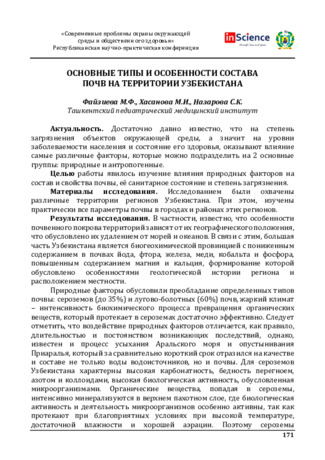 Основные типы и особенности состава почв на территории Узбекистана
Современные проблемы охраны окружающей среды и общественного здоровьяДостаточно давно известно, что на степень загрязнения объектов окружающей среды, а значит на уровни заболеваемости населения и состояние его здоровья, оказывают влияние самые различные факторы, которые можно подразделить на 2 основные группы: природные и антропогенные.
-
 The kaolin of khujakul mine and the results of its enrichment by physical-mechanical method
Green chemistry and sustainable developmentThe ability to obtain valuable raw materials such as kaolin, metakaolin, quartz sand and obtain a number of materials necessary for the national economy by introducing the technology ofenrichment of mineral raw materials available in our republic, which meets the requirements of the time, was successfully tested in laboratory and semi-production conditions.
-
 Scientific and technical efficiency principles for refining of refractory and highly refractory of auriferous ores Kizilkum
Catalog of abstractsThe urgency and relevance of the theme of dissertation. Gold is mined in 72 countries, among which Uzbekistan occupies the 9th place with 103 production capacity tonnes/ycar. Gold mining in the world in 2015 increased by 0.33% and amounted to 2678 tons. Global stocks of deposits to easily extract and a high initial content of gold is now almost depleted and the development involved the extraction of difficult and complex orc processing. Therefore, to date, the current world market is experiencing a clear shortage of minerals.
High gold prices have created favorable conditions for the expansion of the mineral resource base and involvement in the testing of complex treatment of refractory gold sulfide-ore. The main reason for gold strength associated with fine particulate association with ferric sulfide gold (gold particle size is from tens to less than one micron) and therefore it is not dissolved by cyanidation conventional technology, even when grinding without the use of ultra-thin preparatory operations prior to cyanidation. Thin association of fine gold with iron sulphides in the ore and the presence of significant amounts of carbonaceous substances may occur simultaneously (especially persistent ore), which is particularly complicates processing technology.
In this regard, increasing the efficiency of processing of persistent and highly refractory gold ores through the development of technological and technical solutions aimed at maximum opening auriferous sulfides, and the combined technology of their processing, providing additional recovery of gold is an actual scientific problem facing modem gold mining industry and has great economic importance.
This thesis research is oriented on realization of the decree of the President of the Republic Uzbekistan PD-1442, December 15, 2010 «Priority on development of industry of the Republic Uzbekistan in 2011-2015», as well as in other legal documents adopted in this area.
The aim of the research work is the development of technological and technical solutions aimed at maximum opening gold sulphides, and development of combined processing technology, providing additional recovery of gold.
Scientific novelty of the research work lies in the following:
Based on the study of behavior of gold in the process of washing bio oxidation product, it was first established presence of gold in the sink counter current decantation in colloidal form and the dependence of their behavior on the pH of the medium. That case developed bio oxide technology of enrichment by reducing the irretrievable loss of gold (50%) during washing biological pulp;
The cause of the deterioration in clarifying thickeners CCD, which was the salt hydrolysis of Fe+3;
(Variation with pH by washing) in the liquid phase slurry to form a colloidal solution of ferric arsenate and oxysulfatc, leading to an increase in viscosity of the liquid phase of the slurry and decreasing the deposition rate of biooxidation product slurry fraction;
study foaming mechanism during biooxidation detected gold enrichment process (6-8 times compared with the flotation concentrate) by fractionating fine and colloidal gold by flotation factors parts carbonaceous slurry in the reactors;
investigated the kinetics of cyanide thiocyanates during biooxidation product and its participation in competitive adsorption with a cyanide complex of gold and the dynamics thiocyanates content changes depending on the concentration of sodium cyanide and time (10-12 hours), after which the change of its content does not depend on the length process. It is also found that the rate of cyanide leaching of gold is higher than the rate of thiocyanates;
based on the study of the behavior of ion exchange resin in the process of sorption cyanidation products bio-oxidation reduction set sorbent properties after successive cycles of «saturation - regeneration» by poisoning his thiocyanates, which leads to a dynamic increase in the gold content in the liquid tails sorption and reduction of its extraction;
based on the results of theoretical and experimental studies on the state of thermo-chemical processes occurring in the process of bio-oxidation product of oxidizing roasting, set the temperature which determines the role of the quality of the resulting calcine - at a temperature of 570-600°C the degree of extraction of gold is higher than at 650-743°C. This is because at 650-743°C results in the formation of fast films preventing cyanidation of gold.
CONCLUSION
On the basis of the research on a doctoral thesis on «Scientific and technical efficiency principles for refining of refractory and highly refractory of auriferous ores» provided the following conclusions:
1. According to the study, gold properties in the process of washing, the bio oxidation product is first established the presence of gold in the sink of counter current decantation in colloidal form. The dependence of behavior on the pH of the medium on which developed bio oxide enrichment technology by reducing the irretrievable loss of gold (50%) in biological pulp during washing.
2. The reason of deterioration of clarification countercurrent decantation thickeners with salts of Fe+3 hydrolysis (with a change in pH by washing) in the liquid phase slurry with the formation of colloidal solution of ferric arsenate and oxy sulfate, which led to an increase in viscosity of the liquid phase of the pulp and reducing the deposition rate sludge of bio-oxidation cake fractions has been found out.
3. A study of the mechanism of foaming has been observed during the bio oxidation, the process of gold enrichment (6-8 times compared with the flotation concentrate) by fractionating fine and colloidal gold by flotation factors parts carbonaceous slurry reactors has been noticed. A method for processing the foam product, based on the sorption cyanidation gold at higher concentrations of sodium cyanide, which is the most effective compared to defoaming process in reactors.
4. The kinetics of formation of thiocyanates in the process of bio-oxidation cyanidation of products and its participation in the competitive adsorption of gold from the cyanide complex have been studied. Theoretically and experimentally substantiated set content change of thiocyanates cyanidation process depending on the concentration of sodium cyanide and time have been proven. Time for complete formation of thiocyanates is not dependent on the concentration of sodium cyanide, and is 10-12 hours, after which no change in its content depends on the process time. It is also found that the rate of cyanide leaching of gold is higher than the rate of formation thiocyanates.
5. On the basis of studying the behavior of ion exchange of resin in the process of sorption cyanidation of bio-oxidation product is installed after the reduction of the sorbent properties of cycles «saturation - regeneration» by poisoning his thiocyanates, which leads to a dynamic increase in the gold content in the liquid tails sorption.
6. Research has shown the influence of the concentration of thiocyanates saturation of different gold sorbent (resin, coal). In terms of direct cyanide leaching bio-oxidation products concentration of thiocyanates is up to 5 g/1, which is the main reason for the low saturation gold sorbents. Also found that one of the universal ways biological pulp conditioning is oxidative roasting, prevents the formation of thiocyanates cyanidation.
7. On the basis of theoretical and experimental research of thermochemical processes occurring under oxidative firing bio-oxidation product, set temperature determining role in the quality of the cinder. It was determined that at a temperature of 570-600°C extraction of gold higher than 650-743 ° C. This is explained by the fact that at 650-743°C results in the formation of fast films preventing cyanidation gold.
8. Developed and industrialized the combined technology of refractory and highly refractory gold orcs and concentrates containing carbonaceous material, using oxidizing roasting. At the initial stage of oxidation of flotation concentrate bio-oxidation is carried out under the scheme: opened sulfide gold, a significant part of the arsenic dissolved, transferred to the solid state in the form of insoluble scorodite (FeAsO4). Then bio-oxidation product with a low content of arsenic is exposed to oxidizing roasting, in which the carbonaceous gold opened, oxidized remaining sulfide sulfur, destroyed products of metabolism of microorganisms, oxidizing roasting product is directed to sorption cyanidation of gold from pyrite cinders.
9. In introducing the combined technologies of processing and highly resistant refractory gold ores and concentrates, with the use of bio-oxidation product of oxidizing roasting is established that the firing of the product of the charge and Daugyztau and Kokpatas orc deposits in the ratio of 60:40 at a temperature of 600°C for 2 hours and subsequent sorption cyanidation cinder enhances extraction of gold from 73.3 to 82.5%, decrease in consumption of sodium cyanide 2.5 times, reduction Thiocyanate concentration in the liquid pulp phase from 5000 mg/1 to 16.
10. The industrial precious metals recovery technology by improving the technology of sorption cyanidation leaching bacterial product on the basis of circuit testing have been developed and acquired which provide input for the design and subsequent transfer node sorption cyanidation of bio-oxidation product in the scheme of «carbon in pulp».
11. In experimental-industrial conditions of the off-balance sulphide orc gold extraction technology in Kokpatas by heap leaching with continuous bacterial extraction in the order of 50% (versus 25.7% in direct cyanidation) have been developed and tested.
12. The existing scheme and combined technology of processing of refractory and highly refractory gold ores arc introduced at HMP-3 of the State Enterprise «Navoi Mining and Metallurgical Combine» have been developed and improved. As a result of significantly increase of through extraction and annual gold production while maintaining the existing volume of orc processing, reduced the cost of the manufactured product and get the actual total economic impact of 222.2 billion sums per year (prices of 2016). -
 Pollution of steppe soils of southern regions of Uzbekistan with oil and petroleum products and it is reclamation
Catalog of abstractsThe aim of the research work distinguish the difference between the sources of pollution of soils of desert region of the southern region of Uzbekistan by oil and oil products, and to develop biological treatment method.
Scientific novelty of the research work:
for the first time the distances on the pollution sources of several soil types of arid zone polluted by oil and oil products and the differences on soil profiles were revealed;
changes in the organic and anthropogenic carbon, and humus contents of the soils polluted by oil and oil products were studied;
created recultivation technology of combined application of the strains of MFD-100 Pseudomonas stutzeri, MFD-200 Pseudomonas caryophyllis, MFD-5000 Bacillus subtilisfox the arid zone soils polluted by oil and oil products;
developed the individual factors, algorithm and stages of recultivation of the soils polluted by oil and oil products, and done periodization of recultivation process;
rehabilitation parameters and coefficients of soil fertility after recultivation of the soils polluted by oil and oil products were developed. -
 Improvement of technique of prospecting works and increase of estimation reliability of gold ore deposits reserves of Uzbekistan (abstract)
Catalog of abstractsThe aim of the research work is improvement of prospecting works technique and increase of gold ore deposits reserves estimation reliability of three geological and industrial types on the basis of studying of placement regularities, conditions of a bedding and morphological features of ore bodies taking into account definition of the factors influencing reliability of estimation of reserves.
Scientific novelty of the research work:
for the first time for three geological and industrial types of gold deposits of Uzbekistan (gold-quartz, gold-sulphidic-quartz and gold-sulphidic) the it is developed the systematization defining on the basis of regularities and placement conditions technique of prospecting works and reliability of their results;
it is proved that the studied gold ore objects have high variability of prospecting parameters and different degree of the counted stocks reliability;
in a section of 7 gold ore deposits of 3 geological and industrial types on the basis of experimental data the basic elements (parameters) of a technique of prospecting works - prospecting networks, distance between developments, geometrical properties, approbation parameters, optimum prospecting method and estimation of reserves are quantitatively proved;
for the first time in Uzbekistan on the basis of application of GGIS-technologies for estimation of reserves it is shown increase of efficiency of prospecting works, increase in productivity and efficiency of estimation of reserves on average for 30%;
for the first time it is developed on the example of deposits of Uzbekistan the improved "Methodical instructions on comparison of the prospecting data and development data of solid minerals deposits", and also "Methodical recommendations about an assessment of presentability and reliability of approbation of ore deposits".
